Latest Event Updates
Early Success Comes To A Crashing Halt (Chapter 14)
 Quixotic is perhaps the best way to describe this beginning of this epic quest. I had shape without substance which created a hollow man, unable to stand. A hollow man is worse than a straw man. At least a straw man can be ripped apart and repacked.
I was reading more about child mortality and the condition of extreme poverty which plagued many locations which coincidentally were found in developing countries. I was gathering an education safely at arms reach. Statistics galore, and most of the literature was based from the same content generated by the same agencies. Where there was first hand accounts of the problem, this information seemed to be generally written specifically for the purposes of providing a hook to solicit fundraising for a particular organisation.
The United Nations was the leading agency in providing information to inform a global audience on the issue of child mortality. Since 2000, this had become measured in the context of the eight Millennium Development Goals which had received an almost unprecedented support from all member states of the United Nations. The intention was to reduce child mortality by two thirds from the recorded 1990 levels before 2015 when the MDG would be due.
The method I was intending to pursue sought to raise awareness of this situation by running 10 sub-marathons each of 24 km in 10 cities across 10 countries. Initially, I wanted to run in countries which together would help frame a narrative to understand the issue of child survival. It was a global issue in that we were all responsible to help effect a solution. By running, my sense is that during the journey I would learn more about the issue and also have the opportunity to open a global conversation that would address the question of child mortality. I was calling this conversation the Design Forum, and intended to convene this in each location where I ran. I knew the task was difficult, and that was to mirror the fact that reducing child mortality itself was no easy task. I had proposed to run 24 km because it mirrored the information available through UNICEF in 2010 which recorded the 2008 recorded figures for child mortality that claimed 24,000 children under the age of five we dying every single day. This is an appalling statistic, and by running across this distance my sense was that I could make a point which others might pick up in conversation.
I was not new to the United Nations organisation. I had previously had a lot to do with the United Nations in East Timor where I had served as a peacekeeper following the intervention which resulted in the creation of a new state with sovereign independence set apart from Indonesia. I knew of the frustrations of working with the United Nations, and the entrenched culture inside the United Nations which attracted a particular calibre of worker. I had a familiarity of working with the security framework which was the convener for so many issues affecting security in places where through my previous Army experience gave me responsibility for management where the United Nations was the lead agency.
The United Nations is a curious organisation, a sometimes dysfunctional mixture of bureaucracy, corporate communications and good intentions. It is a juggernaut which often succeeds in spite of itself. Opinions vary, and it is easy to be critical of a large organisation. John Bolton, the former US Ambassador to the UN has been among the staunchest critics, with provocative quotes to argue in favour of his perspective such as when he claimed: “The [United Nations] Secretariat Building in New York has 38 stories. If you lost ten stories today, it wouldn’t make a bit of difference.”
My early sense was was that the information I was reading about child mortality from the United Nations showed that the world was coming from a low base to understand the issue. Most discussion I read seemed to promote a view that was heavy on explaining the MDG rather than questioning how people might get involved to make a difference besides signing petitions of making financial donations to large charities. Something seemed to be missing from the conversation.
Early success seemed to come in response to my appeal for friends to help with my crowdfunding effort which I had executed through PayPal. It was not really a good solution for what I was seeking to achieve, because it created a 1:1 relationship between myself and those people I was asking for help. There was not much capacity for people to partner by sharing my vision for success. People seemed to be responding because of the enthusiasm I had for the idea, but also because people genuinely recognised this was a difficult problem to address.
My website was picking up traffic, and I think that was also visitors who were curious about such a bold vision for change. I was buoyed by this support. It was a good feeling that what I had proposed might be possible.
I had promised to start on a particular date that was aligned with the 2010 UNGA at the end of September. I thought that having a firm schedule was important to sell the idea. People had to know what I intended to do, and I also had the need to book flights and warn out places I intended to travel that I would be visiting in the coming weeks or months.
While I had this schedule organised, deep down I knew that it was All Backswing. I had made no contingency in the event that I did not raise enough money, and while the response was promising, I also knew that I was falling short on being about to execute a meaningful intervention. Perhaps I ought to have opened my conversation around funding more candidly, but I thought that if I had done so, people might have understandably asked me to step back from the edge and be reasonable.
How we discuss backswing with others is important. Admitting that we are heading towards possible failure or at least a messy train smash is an important conversation that should be undertaken by those who have invested their time, energy and money into supporting such an endeavour.
I knew a travel agent who I visited on several occasions to plan the route. She was extremely helpful to help map out flights and dates. The endeavour seemed achievable, and there was a known cost for the endeavour which I was fast approaching the requisite amount of money to undertake. For the moment, this was going to happen, or so I thought.
I eventually raised just enough money to pay for the plane fare, and thought I would pay for the ticket which would commit me to action, and from there work out how to fund the remaining expenses even if that meant beginning the journey first with less than the required resources needed and then resolving that issue later.
One morning, I headed to see my travel agent friend after withdrawing from the bank the necessary amount of money I needed for the plane fare. I sat in her office, and we confirmed the route. The total cost was around three and half thousand dollars from memory. She confirmed this, and then said those dreadful words which I had completely not anticipated: “and so the final cost with tax will be…”. Tax! I hadn’t considered the cost of tax. I didn’t have enough money.
As if a small boy in a lolly shop who had counted the coins from his money box in anticipation of buying a handful of chocolates after diligently saving up for this special occasion only to find the cost was five cents more than he held in his hands, I felt awful and embarrassed. It wasn’t the travel agent’s fault. I was responsible.
I had to ask the travel agent to postpone my plans, and that I would work out a way to return in a short while to pay the remaining amount due. It was one of the rare moments in my life when I had wished the building would collapse into a pile of rubble rather than having to admit that I didn’t have the money to pay for the ticket.
But who had been let down? Was I the person let down, or was it the travel agent, or maybe more likely I had let down the supporters by failing to meet their expectations that I would deliver on my intention? In actual fact, the greatest let-down was unseen by us all. This was a collective failure to undertake an initiative. That is not to say this was the only initiative that mattered, but perhaps earlier advice that might have sharpened my resolve or cautioned me about beginning half-cocked would have been valuable so as not to disappoint a long list of supporters who had the expectation that something wonderful was about to take place. The people who were let down by all of this were those who were most in need. These people were real, even if faceless, and not simply a statistical phenomenon.
The wheels seemed to have fallen off my early success. I pondered what to do next.
A Half-Baked Idea (Chaper 13)
 The journey now seemed real. There was a website, and on a map I could trace a line following the route I intended to take, scheduled against dates on a calendar. My training was increasing in intensity, and all of a sudden it seemed as though this journey was going to be easier than I had thought.
I soon realised that I would be unable to complete, let alone start, this quest without the financial support from others. I wasn’t going to repeat the folly of the 9 City Bridge Run and fund the whole trip alone. I knew that whatever the outcome, I would be responsible to meet some of the costs, if not the lion’s share. I also recognised that the financial contributions from others would be more than just passive assistance to meet costs, but more a tangible demonstration of their commitment to supporting the idea.
This for me was the beginning of Backswing. The start of any new idea will be filled with uncertainties. By definition, there will be more that is unknown than known at the conception of a new idea. Speaking into the void and navigating across unknown territory is normal. Those things involve a process of iteration: striking, and sometimes hitting the target, but more often than not finding a route through trial and error.
It is when we seek to have certainty that the paralysing state of Backswing overtakes us. I had reached this point from having earlier attempted something which didn’t work as I intended. I continued to try to make the idea work. But it was when I suddenly felt the expectation of a crowd that the unintended consequence of holding myself in check emerged.
I was doing something I hadn’t done before. I knew what I was delivering wasn’t perfect, but there wasn’t much alternative aside from just giving up. This is the importance of ‘shipping it’ as Steve Jobs and others were so insistence to demand from our actions. But I also knew that there was a balance between shipping and responsibility. What responsibility did I have to ask people to contribute money towards a process which I had more doubts than certainty in terms of the outcome?
I have often been inspired by the early explorers. People who set out across land and sea to a destination that weren’t really sure existed, and without any knowledge of what lay between them and the anticipated objective. Similar to how the Hero’s Journey is misunderstood, we can take a romantic view of the early explorers, and look at the overall sense off adventure, but this is normally a view taken in hindsight. Today, these explorers are seeking to conquer new domains of plumbing the depths of the ocean or seeking to make spaceflight viable for a mainstream passenger.
The success of any pioneer or pathfinder is determined by their ability to forge ahead in the face of uncertainty. To wrestle themselves away from the comfortable mediocrity of Backswing and to push ahead so as to navigate a route to their destination. It is precarious, and at times fatal.
In this regard, perhaps my mistake was not being more transparent with my doubts and uncertainty. It is not as though I was being disingenuous. I wasn’t holding out on people, but sharing a vision and asking people to join the journey. In some respects, it was perhaps a good thing that I was not too cocky because if I were there might have been no social constraints I imposed on myself for seeking the support of others.
This early beginning in cringeworthy to look back on. It was August 2010 when I first posted the website. I had an aspiration to commence in New York after the conclusion of the United Nations General Assembly which took place at the end of September. The idea was half-baked, but still it was a good one. It might have been a good idea, but there is nothing more important than execution. A sexy idea is no good if it can’t be acted upon.
I started a newsletter. It was homespun, and I should have appreciated that this involved me seeking the help from designers who might have been affordable. Today, at the time of writing this book, cheap help from the market is widely available. Back then, it was more elusive, and perhaps fair to say that I was more likely to get fleeced from a designer rather than finding a hungry developer to work alongside for our mutual benefit.
I wrote to my immediate email list. Each email was written individually. I didn’t make an email list through mail chimp because I hadn’t sought the permission from these people for this distribution, and I didn’t want to become a spammer. Looking back, there was an easier way, but that was where I was. I had my own financial constraints, so I was working to real limitations too. There was no money tree that was enabling this endeavour.
Part of my method was to test the question asking what influence the individual could have in shaping an outcome. I wasn’t imposing constraints that might limit this question, but it also meant that I needed to act as an individual and not to sublimate my identity to those of a larger organisation. In doing so, I wasn’t railing against the institution nor questioning the legitimacy of organisations. I had spent many of the previous years since 2004 examining the role of social entrepreneurs in and on society, and I wanted to test the rhetoric which often bandied about. There was more to be said about the influence of individuals working collaboratively towards a shared aim. It wasn’t something that I could just write about. It had to be practiced in order to prove.
I knew I needed to fund this quest, and so my attention towards crowdfunding as a solution. Kickstarter, the US crowdfunding platform, had existed for just over 12 months and wasn’t a service I could draw upon outside of the US. I wasn’t prepared to extend the risk and responsibility for funding onto others living in the US in exchange for access to their bank accounts as a proxy where any crowdfunding might be deposited. I needed to find a local solution.
This half-baked idea was being propped up with an architecture of other half-baked ideas. This is not necessarily a bad thing, but it does create a dynamic and fluid situation that is then hard to describe to others with a high degree of certainty. The less stable the idea, the more likely change will be encountered through the necessary and iterative process of innovation. In many respects, in creating something new it is the optimal state to begin with because it allows greatest flexibility for adaption. It also creates difficulty in that people who are new to the idea might find it difficult to understand what the idea is, or see the holes which might lead them to lose confidence in the ability to deliver an outcome.
I was going in blind, but if I was going to do this, I needed to make a start and work it out from there. I was also concerned about the dilemma I was soon to face: how would I communicate and sell this half-baked idea to others? Who would buy into this idea? Would I make myself a laughing stock by presenting an idea that would fall completely flat? I had no idea where this would go, but my vision for what I wanted to achieve in terms of the method was strong.
During this time, my running training was advancing from strength to strength. I was making good process across distance, with good speed, power and endurance, and very satisfied with the results I was achieving when measured against my heart rate. But because the idea was half-baked, I was reluctant to talk up my training. There were others who were stronger, faster, fitter than me. It was a mistake for me focus on what I was not. None of us are ever going to be good at everything. Get started. Now. Ship. Don’t wait for the critics to tell you what is wrong. Damn the torpedoes!
I was running in silence. There was a lot of enjoyment that I found from my running, a sense of accomplishment in being able to complete the epic task I had set myself, and this was a necessary part of achieving the endstate of improving child mortality. This silence was in part the result of a timidity and reluctance to share wholly about the quest I was engaged. If we only focus on the hitting publicly but are not prepared to discuss our misses, this will only lead to Backswing. We have to own our performance. Self-sabotage will override our best intentions if we are only prepared to share the success with our audience because we feel sheepish about starting from a half-baked idea. Swing early, strike out, but in doing so, learn.
And so I posted the first emails. That was a lumpy and imperfect process. I’m sure the emails were longwinded and incoherent compared to what I might write today. One lesson I leant in the army was that sometimes you just have to go with what you have got. It had begun.
Very quickly, I received my first supporter, and this was from my father. You might remember my earlier chapters where I talked about the building of this human bridge with my father as a consequence of undertaking the 9 City Bridge Run. I don’t think we ever recognise the full utility of a human bridge when they are first formed, besides which human bridges are not constructed for their transactional value or what we will get out of the relationship. Human bridges are about what we give, and also how together we can help others rather seeking to be self-serving.
The response from my father came within a few short minutes after posting the email. It was as though he had been waiting for the opportunity to help. I was was of course delighted. I had some social proof of the idea, but more importantly I had the confidence of my father supporting my initiatives. I’m sure he took the view that he was encouraging me to live my dreams regardless of the outcome. That too is a true gift. We should value this more than anything else.
A half-baked idea is not necessary bad, and it is a beginning. Especially if you are beginning somewhere new, that first idea will be lumpy and rough. Accept it, and work from there. Allow others to become part of the process. Take time to celebrate the beginning, don’t be too concerned about how bad it looks.
Coffee In Surry Hills (Chapter 12)
 You have to remember that I am writing this book many years after the events took place. Even so, in some cases, it feels is as though the events were only yesterday. In the case of the 9 City Bridge Run, that was actually last decade, almost eight years ago.
I wrote the after action review mentioned in Chapter 10 following a public forum which I convened to open a conversation addressing wellbeing as a counterpoint to depression and suicide as a result of the 9 City Bridge Run. I actually felt numb and stupid when reflecting on the experience. What had I done between 2007 and 2009 that made any difference to anything? My efforts seemed to have resulted in collateral damage with me as the casualty, and not much else. If I had known then that it would be a long eight years before I made sense of this journey through the publishing this book, I don’t know if I would have had the grit to continue. Sometimes it is better not to know how bad it is going to get when you are at the beginning of an epic quest.
I knew after reflecting on the 9 City Bridge Run that if I did nothing with the experience, then it would amount to failure. I had learnt something, but the problem was that it wasn’t exactly clear what I had learnt at that time.
I wanted to try again because I knew it would be possible to make some difference through this method. I didn’t know how exactly, but my sense was that it was valuable enough to try. Cast your mind back to the earlier chapters where I defined the genesis of this idea and you will see that it was never about how far I could run or even about me being at the centre of the action. In some respects, this created some dissonance in how I felt later. More often than not, I felt uncomfortable in needing to take the limelight. Overcoming our crippling insecurities is just another part of the Hero’s Journey. The insecurities that we allow to dominate our minds is also a key reason for getting stuck at All Backswing.
My sense was that the imperfect method which had proven so problematic and which I was exploring was worth pursuing further. For some reason, the idea of running across bridges to build bridges was an idea I couldn’t let go of, and maybe that was my folly. As I considered how to take the idea further, I felt turned off advocating further on the issue of suicide largely because of the lack of assistance I had received from the organisation who I had intended to support during the 9 City Bridge Run. I also recognised that for as important suicide was to address, there were more pressing issues that I could influence.
My aversion to continue with addressing suicide as the key problem was a case of institutional Backswing impacting on the individual. On a personal level, Backswing holds us back. It cripples our potential. On an institutional level, Backswing cruels a brand. In both circumstances, this occurs without the person stuck at Backswing not fully appreciating how short of their potential they are falling.
I have since formed a view that how we come to be involved in an issue is almost as important as what we do itself. Have you seen this before: organisations where the conversation makes sense, but somehow seems forced? There is something mechanical about the delivery which doesn’t seem quite right. I think too often the not-for-profit world is weakened by organisations who seek issues to champion because of their capacity to reduce tax through their legal status where they are able to exploit cause-related marketing, rather than being a feisty collective of activists wholly motivated by a deep-seated passion to see change occur whatever the cost because of their own personal interests.
It matters why we do things. I am increasingly convinced why we do things is more important than how we seek to do the work. We must strive to resist a culture of philanthropy which is grounded in building the perfect fundraising machine, which although efficient is disconnected from impacting the mission with authenticity.
This is not a new idea. As a society, we have been sold a pup because so many not-for-profit organisations manipulate their marketing to influence our donations. It is the same problem around corporate social responsibility which is at times dumbed down to a branding issue in the name of cause-related marketing.
The answer to this problem I think is to increase our tolerance for the failure for not-for-profit organisations (not so as to bail them out, but to let them perish if they are ultimately unviable). People shouldn’t pursue failure, but if failure is the result of an attempt to realise a noble outcome driven by passion in the interests of achieving change, then can we not see this as somehow worthwhile? It is better than corrupting an entire system with a flawed DNA that serves the interests of no one except so as to make annual reports and the reputations of executive teams sing.
How willing are we to make ourselves vulnerable in the service of the larger task? Our reluctance to accept vulnerability at an institutional level is the point where a state of All Backswing can often emerge. There are so many people who don’t want to have their expectations failed, that they would sooner preserve the certainty of the status quo that seek the necessary path that leads to change albeit inherently risky. We have to swing at the ball to hit, and this is a risky process. Often, we are going to miss.
As individual actors within the institutional construct, we have an responsibility not to buy into the delusion that everything is ticking along just fine. We must demand transparency. We must be obsessive about hitting hard, not only the glamour of the wind up during Backswing. If Backswing is all you have got, the bat will never be placed in proximity of the ball. But that is half of the reason for having All Backswing: it negates the responsibility for hitting.
An organisation that gets transfixed around budget when they should be focused on mission is avoiding the hard task of combating a real systemic problem in society. And in doing so they are becoming complicit with the problem, enabling it to fester.
If you have ever been in a state of poverty and then released through the kindness of someone else without any expectation or ability to pay this back, you will know what I mean. It is an overwhelming sense of freedom, which is incredulous to comprehend at first, and so slightly different to joy. Being received from poverty is a humbling experience where there is no one to thank because their actions were made from a true position of philanthropy. There is no branding. No good photos for the annual report. No humblebrag speeches by a puffed up CEO and Chairman. It is charity at its finest.
This is where not-for-profits should be aiming to get to, a position of true charity, preferably in a way that also enables systemic change. There must be a driving desire, a deep dissatisfaction with the status quo that allows injustice to continue. This dissatisfaction must drive a search for new models and innovative interventions. While it does feel good to receive the thanks from others for helping out, this praise ought to be seen as less important that the opportunity to create the preconditions for others to “pay it forward”. We should have a sense that our satisfaction to help others is just as important as our need to eat and breathe. Helping others is an innate need we all have so as to be fully human. And this authenticity in connecting with our humanness is the foundation of our motivation to build human bridges that help others.
I thought long and hard about what issue I could address which I thought mattered most with the greatest need to address. I was also interested in addressing an area which also correlated with an issue that was lacking an abundance of interest. It had to have meaning and impact. I wasn’t interested in just joining the beauty pageant of cause-related marketing and so to what was sexy and popular at the time.
I narrowed this down to the problem of extreme poverty as it affected the bottom billion, especially through child mortality. I didn’t have a robust understanding of this, and most of my knowledge relied upon books and presentations I could find. What seemed clear to me was that there were some committed practitioners doing some amazing work, but also many institutions just presenting statistics and data to in effect tug on the heartstrings in order to appeal for change. Tugging on the heartstrings is good for fundraising, but I would question the effectiveness when it comes to radical and massive systemic change.
I knew there was something I could do to influence this situation, but I didn’t know what exactly. I could have been more bullish in expressing my lack of knowledge of this problem. Leading with questions is a very important intervention in any area.
It so happened that a friend of mine called Ruthe who I knew through my earlier foray examining social enterprise across the UK and US let me know of her friend Kelley who was soon to visit Sydney. Rathe asked if I could connect with Kelley in Sydney and show her around. Of course, I was delighted to help and so I met Kelley in Sydney and had a great time showing her around. One morning, we stopped in a cafe in Surry Hills for coffee. The conversation was good, and after some general chit chat she in true New York fashion called me on my bullshit. So what is really going on, she asked. She wanted to know what I was doing or more to the point wanted to do.
I explained that I was playing around with this idea involving running across bridges to build human bridges. Kelley listened very patiently and with great care. She led me through a process with some subtle questions that would lead me to take action a short while later.
I remember that during this conversation I confided in her a question which I was hiding from answering. Did I think it was alright if I put this idea about running sub-marathons in 10 cities across 10 countries to somehow impact child mortality out there on a website? She responded saying with good humour that unless I tried I would never know. Looking back, that is so elementary. It was one of those threshold conversations that gives ourselves permission to depart from the Ordinary World and embark on a journey which is far from certain.
To her credit, Kelley didn’t try to counsel me to avoid the uncertainty of a personal quest in preference to working through an established global not-for-profit organisation. Safety was never part of her considerations, and at the same time she was far from encouraging recklessness. I still remember Kelley giving me this permission to try something that might not work without any hint of censoring my aspiration for what might be possible. Looking back, it was an insight into the process of innovation.
Journeys take a path few of us can predict, especially as we venture out from the Ordinary World. Kelley was one of those supportive characters who act as a guide and ally though the Hero’s Journey. It was significant that she was there at the beginning of this journey, because coincidentally she was also the one person who would eventually be sitting patiently and listen to what had taken place across the many years which spanned this quest at the conclusion of the run in New York. Never underestimate the impact that other people are going to have in your life. This journey all began with a coffee in Surry Hills.
And so I launched my first website. I was very aware this was a new skill I had to acquire and I was far from being an expert. I was finding that it was necessary to jettison my familiarity with being a highly competent expert in my previous work as an Australian Army Officer, and to learn to embrace the beginners mind again. Admitting that you really have no idea what it is you are trying to achieve is a difficult place to find yourself.
The Myth Of The Hero And The Truth About Collaboration (Chapter 11)
 Joseph Campbell is the author of The Hero With A Thousand Faces and the person who is largely attributed for bringing the concept of The Hero’s Journey into popular culture. He is known for shaping storytelling, and is often seen as a key influence on the great film-makers. I also believe that the idea of the Hero’s Journey is greatly misunderstood.
“Follow your bliss” is one quote for which he is well known. His work describes the path of a ‘hero’ when through circumstance they find themselves entering an unknown world after answering a call to adventure. Through the process of engaging on this journey they are tested, the result of which is a process of transformation. Through a process of rebirth largely as a result of the people encountered, the hero has an irreversible alchemic experience.
The heroic is a romantic idea. Particularly in the West, we celebrate the triumph of the lone hero receiving the accolades of many. The traditional model for leadership takes a similar view which describes the lonely journey of the leader at the top of an hierarchical totem pole.
It is as thought we are willing the hero to be the saviour of the normal world which we inhabit. If the entertainment industry was any measure, it would be fair to assume that we are waiting to be rescued by flights into fantasy. We want our lives to be changed by the hero. And I think this is a mistake in how the hero is often perceived. The Hero’s Journey is perhaps more about what happens within the hero to share them indelibly, rather than to provide an action narrative which we as observers can celebrate. It is the hero who is the malleable canvas ready to be shaped and coloured. It is a visceral experience.
We want to observe an heroic narrative which is dramatic and spectacular. But I don’t believe this is realistic, and is the reason why I believe the Hero’s Journey is misunderstood. The difficult process of transformation is mostly mundane and banal, but at the same time intensely uncomfortable. I believe this is what makes the Hero’s Journey so difficult, because the trials are easily overlooked by people other than those intimately involved in the experience. Departing our Ordinary World involves risk that few are prepared to accept. In a similar way, few people want to talk about the discipline needed to address the boring and tedious work that is essential in enabling heroic quests to be accomplished. Heartbreaking failures that take place during this journey often occur at the loneliest and most vulnerable of times.
I am not suggesting that to understand the heroic it is necessary to fall in love with the mundane and the difficult, but without this discipline we won’t encounter the heroic. The mundane does not make for a good story. There is no gripping “what happened next?” moment with the mundane. The mundane is not interesting. It is tedious and mind-numbingly unbearable.
The Hero’s Journey is fraught with danger. There is no guarantee that the journey will succeed. The hero also has no idea of where the journey will lead. It could be a hopeless and pathetic journey of waste and loss.
Danger comes in many forms and I would argue that a moral, even existential, danger that tempts a person to succumb to mediocrity because of the absence of financial and emotional resources is the most troubling. The Hero’s Journey is actually about plumbing unknown depths into a place that cannot be visited willingly. The unglamorous journey through poverty and rejection is more than likely to be that thing that creates the hero more than the physical confrontation of danger. The difficult journeys are the ones which we find during the dark night of the soul.
I met with my friend Cynthia in New York for breakfast after I completed the 10 City Bridge Run journey. It was good to see her as I have always admired her work as a designer influencing change for those most in need of help. She has always had a kind and sympathetic ear to what I have often thought was my own clumsiness in trying to make things happen. Over breakfast she listened as I told her about what I had been through. I think I was trying to make sense of my folly more than tell a story. She sat with an intense gaze, as if astonished to see something obvious that was hidden to myself. “This is the Hero’s Journey” she uttered at one stage, unprompted.
My journey on the 10 City Bridge Run was a result of the difficulties encountered. What transpired was different from the romance that I had envisaged at the beginning. Although more difficult, it was also sweeter, more satisfying in some ways, and these often came at the lowest points. I remember well the cold splash of rain in Brooklyn on that last leg running through a wet and dark night in New York and just knowing that the journey would somehow prove worthwhile.
Self-identifying the Hero’s Journey is an act of great pretentiousness. I sense that the power of the story is lost if we lay claim to ‘the hero’s journey’. It is almost as though only the audience can observe what is happening, as was the case with Cynthia.
We want to see the hero as a lone actor, that person who has what it takes to get through the storm. But the reality is that there are no lone actors in the heroic realm. No one ever acts completely alone. The subtle influences from others shape our behaviour. The lesson here is to not underestimate the impact of your actions and words on others.
The person who sits in a log cabin alone and isolated from the world only really becomes a hero because it is in relation to how this affects or is affected by other people. There is a bridge between us and others that is of critical importance to build. This bridge might come after the hero’s death. If we are lucky, we will see a reference to our actions as heroic while we are alive. This is a human bridge with far more dimensions than simply an extension of our resources to help others. The human bridge is also that essential connection to others through which our lives are given meaning.
A radical collaboration is at the heart of the Hero’s Journey. It is not the trials that we go through, but the involvement of others that gives our journey meaning. We can’t schedule in collaboration: we can make time for it, but there is a magic, an alchemy, which comes about when others shape the adventure we are experiencing.
The concept of Backswing is about this shared journey. Backswing focuses on the central actor of the batter, but actually it is grounded in collaboration. It is a natural tendency to hold ourselves back at the wind up of backswing, and to balk at attempting to hit the ball. The responsibility to hit and not to miss can result in fear. Consequently, we want to stay in the comfortable space of All Backswing. That comfortable space is the Ordinary World of the Hero’s Journey. But the reason for Backswing is to hit the ball. It takes commitment to release the bat and follow through to hit the ball, smacking it out of the park. The authentic swing described by Steven Pressfield is effortless and feels good. But are we prepared to let go of the Ordinary World in order to find that passage to our own internal transformation?
The 9 City Bridge Run was a difficult journey that at the time seemed to me to be a colossal failure. This experience was repeated during the 10 City Bridge Run. It was only that I kept forging ahead on this epic quest that I have been able to get to this point to write this book for you.
The journey continues, unfinished. It is also an invitation to you to leave the Ordinary World, if you dare…
“A hero ventures forth from the world of common day into a region of supernatural wonder: fabulous forces are there encountered and a decisive victory is won: the hero comes back from this mysterious adventure with the power to bestow boons on his fellow man.”
― Joseph Campbell, The Hero With a Thousand Faces
A Reflective Think-Piece On Resilience, Connectedness, Failure, Courage, And An Industry Of Fundraising (Annex B: After Action Review for the 9 City Bridge Run)
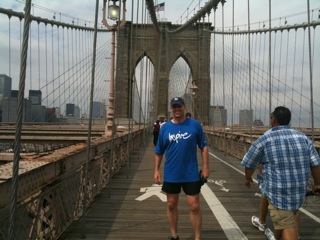 The 9 City Bridge Run was a global endurance challenge where Matt Jones ran nine sub-marathon distances across nine cities in five countries in the space of one month between 4 September and 5 October 2009. The cities were: San Francisco, New York, London, Oxford, Dublin, Tokyo, Alice Springs, Canberra and Sydney. A blog record of the event is at http://www.9citybridgerun.com.
The purpose of the event was to raise awareness of resilience and wellbeing as a counter-point in addressing the combined prevalence and stigma of depression, anxiety and suicide.
A free public forum was held at the Barnett Long Room in Circular Quay, Sydney on 26 October 2009 to culminate the awareness raising effort from the 9 City Bridge Run. The event was captured on video and is available for people to see online.
The symbolism of a bridge was used as a metaphor connecting people, communities, cities and ideas.
This After Action Review is written in the form of a personal reflective think-piece on resilience, connectedness, failure, courage and an industry of fund-raising. These are issues of social leadership affecting how we care for our people and our cities (be that defined with a local or a global perspective is entirely at the discretion of the reader) which should prompt discussions about the efficacy of fundraising and Corporate Social Responsibility programs aimed at affecting social change.
This review is written in the first-person as it is mostly of a personal nature. These comments reflect my experiences and observations, and are intended to be objective and constructive. I welcome an active process of sound ethical deliberation to explore differences of opinion, and encourage people with similar or alternate views to pursue discussion in this spirit by contacting me directly or sparking conversation via social media.
The comments in this report are personal, and shared in the interests of stimulating discussion and awareness of the importance of resilience and wellbeing. Due to their personal nature, while the report is ‘open source’ a Creative Commons Licence applies allowing redistribution with no derivatives and attribution for non-commercial use.
Acknowledgements
I wish to thank in particular the City of Sydney for making the venue available for the awareness raising talk, particularly at short notice. This showed a real commitment to the community they as a city serve, and also through their openness to more fully enable the exploring of the issue.
I especially extend thanks the three speakers for the evening, who gave freely of their time for the benefit of those who participated in the discussion:
- Dr Tim Sharp: Chief Happiness Officer, The Happiness Institute (www.drhappy.com.au)
- Lyn Worsley, Clinical Psychologist and Registered Nurse, Child, Adolescent and FamilyTherapist (www.lynworsley.com.au; http://www.theresiliencedoughnut.com.au)
- Professor Ian Hickie AM, Executive Director, Brian Mind Research Institute located at the University of Sydney (www.bmri.org.au)
Approximately 60 people attended the event with a similar number of RSVP responses showing interest however unable to attend.
A broad range of not-for-profit organisations involved in the area of community care were unable to attend but were engaged in discussion regarding the issue. These were invited to attend via a formal process as requested by the City of Sydney.
I speak for all who attended the presentations, and especially from a personal standpoint, in thanking the speakers for their responsiveness at short notice and the generousity by which they contributed to the event and discussion.
Background
I was motivated to undertake this activity by the (unexpected) suicide of several close friends, along with the personal knowledge of chronic depression of other friends.
The genesis of this event was a conversation with two other classmates from my secondary school (Melbourne High School). Less than five years ago and over the period of three years, two other friends from our cohort at school had suicided. As it had turned out, I coincidentally had arranged to meet for dinner with the two classmates (who did not suicide) around the time of each incident. We discussed the events, and thought about what we might do in response to these deaths. It would be fair to report that we experienced a degree of frustration in exploring this issue. We knew we wanted to take action, but knowing exactly what we could do was elusive.
Noting the death of friends, I determined I was not going to be yet another voice saying that ‘I must do something’ at the wake, only to take no action except slowly forget about the experience over time.
In hindsight my efforts were well-intentioned but from a professional perspective could be described as inefficient. I pose the question: ‘Does a sub-optimal performance constitute failure when it is for the public good?’
Given that all expense was met by myself in organising and the conduct of this event and that the only loss that was suffered was really by myself in a financial sense and in terms of physical and emotional exhaustion, the concept of ‘Return on Investment’ and efficiency of conduct is possibility no one’s business other than my own. I have shared it here because I think it presents important lessons for other like minded nudgers in the community from which to benefit. The sharing of these lessons and observations is in fact a continuation of my intention and the purpose of the activity.
On a positive note, speaking with staff at the Melbourne High School last year I was advised of a program for all Year 10 students recently introduced which encourages their investigation of resilience, care for others and issues of mental health. The program at the school has been successfully developed and has demonstrated a good impact in informing students. Such programs that influence change in how the issue is perceived at a young age are important.
General Overview from The Run
I found the event exhausting, both physically and emotionally. This was compounded by the great burden of time, expense and opportunity cost. During the run I felt very isolated, exacerbating the physical and emotional burden generated by the task.
There was much to improve upon in my efforts for the run. There was a considerable gap between what I had hoped to achieve and the actual outcome. Reasons as to why this was the case related to issues of time, support from a credible team, realistic planning and an underestimation of my own capacity.
Defining success became a challenging concept, and I felt tension between an expectation for fund raising with the realisation that awareness raising was of greater importance to the issue.
The Talk- 26 October 2009
The talk was organised with short notice at the insistence of a number of close friends who were also parents of teenage children and concerned at the lack of resources they could identify to support their needs when managing difficult situations involving their children’s wellbeing.
There was healthy differences in opinion in some views which were explored in conversation. I have summarised some of the key points presented without attributing comments to particular presenters. Please note that a discussion of resilience and wellbeing contains different views, and that this is a summary of conversation but not necessary does it imply these comments are either reflective or endorsed by the speakers professionally.
Key points raised included:
- The importance of rethinking individual wellbeing, from a position of treating illness to moving ‘above the line’ where consideration of wellness is as important as moving away from illness (where ‘0’ sits ‘on the line’ and a negative figure ‘below the line’ would mark ‘illness’ and a positive figure ‘above the line’ would mark the capacity for increased richness in our lives. An experience might extend from -10 to +10, and in which case it challenges the traditional notion of psychology which treats ‘illness’ to the point of good health, but then hands off responsibility for the patient.)
- There is a wide range of options otherwise not considered as relevant or important for treating illness/ improving resilience and wellbeing. An example of this might be found in the realm of ‘Positive Psychology’.
- The use of different sources and new technology in making information accessible is important in exploring coping mechanisms available.
- The metaphor of the bridge is useful in considering how communities might connect to find greater resilience.
- There is importance in addressing and exploring the feelings of being overwhelmed and needing to find a way out. Finding someone or some organisation to do this with. The use of public spaces and design is increasingly important to enable how this might occur.
- Being connected through ‘work’ and the importance of participation in our societies. This presented notions of a ‘retirement age’ as not something that should be regarded as necessarily how things should be, and possibly a concept that could be restrictive and unhealthy. This is not so much because of the fiscal burden of retirees on the State but more to ensure a framework of social and productive activities remain. The utility of work as contributing to our social processes and having an influence in the dynamic of relating to people.
- The concept of a ‘resilience factor’ at an individual level, and the shared aspect of this on a social level. How this affects decisions we might make about redefining our lives.
- Productivity Commission, as opposed to the health paradigm, and this presents the advantage of Positive Psychology.
- The degree of connectedness matters. Healthy relationships not the numbers of connections matter.
- Mutuality- the idea of people looking after each other. This also contributes to having and increasing options for developing resilience and coping mechanisms.
Seven Observations from the 9 City Bridge Run: activity, discussions and forum
- Change does happen. The work of organisations like Beyond Blue and the example of the high school program show that it is possible to address the stigma surrounding this issue.
- Small things people do matter. The most meaningful and rewarding discussions I had during this journey were in unexpected and somewhat intimate conversations with people I met. There was no fanfare or publicity of these conversations, but I suspect there was a high likelihood of follow-on ‘ripple effect’.
- Overcoming stigma is very important. For as long as the stigma remains, even well conducted fund-raising efforts will not create the social change required to affect the prevalence of this issue.
- Awareness raising is more important than fund raising. Ultimately, money alone will not solve this issue. Neither will ‘awareness weeks’ and publicity campaigns on their own. It requires the concern and engagement from a collective effort within the communities we are members of, which requires a change in how we see the issue.
- Engaging in an issue like this can be extremely exhausting. Intervention is both an ethical and pragmatic issue. It is not simply a matter of wearing a wristband or checking a box as a sign of support.
- Responsibility for this issue is a matter for everyone in the community, not to be ‘outsourced’ to only large organisations which can demonstrate ‘capacity’. It is both wrong and ineffective for people to assume the problem has been dealt with because a large organisation achieves successful cut-through in commercial media and messaging. This responsibility includes active engagement in public debate about the distribution of resources and design of spaces.
- Paradox. Our society today is so incredibly connected that there should be no reason anyone should suffer in silence in our communities. The reality however is unfortunately different.
General Comments: Observations and Reflections
The question of resilience is an important trait to be understood, appreciated and developed in our communities. I discovered that my personal reserves and default response for resilience is relatively strong due to my Army background and experience. This was described by a friend as being not entirely a positive trait at times of stress if combined with a reluctance to reach out for help and declare a sense of need. In such an instance, rather than resilience this is in fact a form of weakness.
The point of this comment is to demonstrate the complexity in the nature of resilience. The Western paradigm, particularly among males, of just ‘sucking it up and toughing it out’ is something that we should regard as weakness rather than attributing to resilience. Unless the conversation in different cultures and communities globally can explore these taboos and stigma objectively I fear that the conversation about resilience will continue to overlook the denial of strong but flawed people (often men) contrasted with the feel-good ‘outsourcing’ of real care and engagement through well- intentioned but ineffective fundraising efforts.
There are many commendable examples of community engagement in our communities. I highly regard the speakers from the Talk as sound leaders for their professional and personal commitment to making a difference. Organisations like Beyond Blue have been instrumental in leading a vanguard of tackling the problem of stigma and taboo of depression in Australian communities.
Increasingly, the conversation needs to be about ‘us’ and not ‘those out there with the problem’. The concept of community is that it is something which we are all very much part of, not an opt-in organisation where we can remain unaffected by issues that we think belong in the ‘too hard’ basket.
Sitting writing this report in Seoul (South Korea) during May 2010, I read in the Korea Times that suicide levels in Japan for 2009 exceeded 33,000 people which is an awful fact to consider. South Korea reportedly has the highest rate of suicide in the OECD.
Visiting New York in April this year I read in the New York Times that suicide and attempted suicide figures among returning military veterans in USA are endemic and are sadly symptomatic of the stigma and representative of the prevalence. This is but one professional grouping among many which has high incidence of suicide compared with societal norms. As an Australian Army veteran myself, I am aware as how much culture plays into this situation, and how ineffective publicity campaigns and awareness weeks are in making a difference to certain employment groups which statistically show a prevalence to depressive illness or suicide (such as has been recorded among lawyers and dentists).
The response in this particular report by the New York Times saw the military commander issue a directive that such behaviour (suicide) must stop as it is bad for morale. As comical as that might sound, are some publicity campaigns any better or more effective?
Recently in Newark (New Jersey) during April 2010, I was informed of the statistic that the leading cause of death among a demographic of young African American males is homicide. If in Australia for the same demographic the leading cause of death is suicide, then this presents a tragic commentary on the society both we in Australia and America live within, and should challenge us to re-examine the concept of resilience of community and ‘mateship’ which we are all so proud to celebrate.
Especially so during a time when so much fundraising effort goes toward addressing ‘global poverty’ using the promotion of data such as the 21,000 children under the age of five dying every day from preventable illness caused from exposure to extreme poverty. Sadly, the unseen reflection this holds for our communities is the immense ‘poverty of spirit’ which is so insidious in large cities. More so, this poverty of spirit is ironically often to be found within wealthy enclaves in our communities. People have sometimes joked with me about the irony that New York can be the loneliest city in the world in which to live…
Aside from the personal grievance that suicide creates for the families and friends of those Australians affected, in considering a response to the problem of ‘global poverty’ an economists perspective might identify the inefficient loss of a scarce resource, namely bright-minded, able-bodied youth who could otherwise be so much better engaged to influence those in real need across the globe.
How incredibly sad it is that in our society of accessibility today there can be any problem worth killing yourself over at such a young age.
The prevalence of this issue is outrageous, and tragically remains muffled by the stigma with which the taboo is accompanied.
Timing
The conduct of this run was an idea I had been sitting on for over a two year period. A window of opportunity arose in terms of my physical ability to undertake the event and time to commit to the activity prompted by the suicide of a friend. The impact of illness and injury during my lead-up training made me less certain about making public statements about the task ahead as I has no evidence other than personal determination to suggest that I would be able to complete the run.
Observing decision making
The activity itself was something of a difficult nature and tested me fully, often leading me to appreciate small decisions about conduct as big ethical decisions relating to the integrity of the event. (For example, at the far point in a run around the Thames: would I just stop and catch a bus home? Did it really matter as no one was watching and no one was recording what I was doing? Was there a point at which the act of attempting the feat was enough? Did it matter whether I finished each city run or not? At different times I questioned the significance of my actions as there seemed to be no interest or monitoring from the Foundation for whom the money was being raised. This made me question for whom was I doing this, and did my efforts really matter?)
The event became intensely personal.
The run ironically turned out to be an unintended exercise of active experiential learning revealing a situation analogous with the nature of depression as was described by friends who confided to me the nature of their chronic illness before and during the activity. The correlation with an experience of depression is perhaps best summarised in three broad areas:
- The event, like depression, came at significant cost- physically, emotionally, financially, professionally.
- Little choice over the timing- I commenced the event on a particular date, however due to an unrelated elbow injury leading up to the run, I was not optimally prepared physically. I did gain my doctors clearance before commencing the event, although this came with some reservation and advice of caution. As such, particularly after the third leg of the challenge I found that despite being committed to the task my body was increasingly physically unprepared for the demands which I was asking of it. Friends speaking about their experiences with chronic depression have indicated that all the positive thinking in the world is not enough to combat the deadening malaise which the condition presents.
- The effects of what I was doing were unseen by those around me. For whatever reason (I have identified the reasons, however they are unimportant to this observation in a relative sense) I failed to generate the necessary level of institutional support, media interest and meaningful social media following to create a strong signature of my activities. By the end of the event I felt like I had been running ‘Forrest-Gump-like’ and questioned myself at length the worth of my effort. Friends have spoken about the extra difficulty created by depression aside from its stigma due to its unseen nature. Everything appears ‘normal’ from the outside.
Lessons learnt: Resilience and wellbeing framework
I developed a framework for improving resilience and wellbeing during the course of the event involving four key actions:
- Increasing options available
- Mitigating feelings of being overwhelmed
- Avoiding disconnection/ disconnectedness
- Developing a rational approach to responsibility for one’s own situation (feelings and thoughts)
That it took me close to six months to complete this relatively simple After Action Review is perhaps evidence that I myself did not manage my own personal resilience and wellbeing in this situation well. I observed that knowledge is useless unless it is applied, and support networks are redundant unless utilised. Similarly ‘brand’ of a large organisation involved in addressing issues of mental health is a meaningless commodity to someone in need.
I did see my doctor on arrival back in Australia due to exhaustion, and perhaps erroneously this was the only counseling I received as a form of debrief from this experience, contrary to his professional advice and recommendation. Again this is at odds with managing the framework which I had developed. The reluctance of people to confront this issue due to the stigma attached is totally underestimated in our communities. The assumption that someone who is need from depressive illnesses will look after themselves because they are known as capable, strong or responsible is entirely flawed. Be it the bravado of a male culture in Western societies or the ‘face’ culture of Asian societies, the stigma which exists holds great influence making this issue of great taboo. We need to be more caring in the way we respond to others in our communities, which applies to those we don’t know as much as those who we know as friends, family and work colleagues.
Resilience ought to be something we understand as:
- Characteristic of our communities
- An ethical response that goes beyond the consideration of ‘what ought I to do?’ to ‘what ought we to do?’
- Openness to a broader range of ethical questions affecting the engagement within communities of ‘how ought we to live better (more fulfilling) lives?’
An understanding of resilience and wellbeing should go beyond discrete sponsored programs and initiatives and have a greater impact when developing and shaping policy in any organisation, be that government, business or community group.
Planning and organisation- seeds of failure?
There were significant weaknesses in my planning, capacity and estimation of the project itself. While tactically these were perhaps areas of ‘failure’, I have questioned myself at great length as to whether did these define the event as unsuccessful. Certainly in a sense of the amount of money raised, if this was the sole measure of the success of the event then the experience may be regarded as a failure.
Accountability
As all expenses were met by myself, I found there was no external accountability during the conduct of the run. All donations were paid directly to the supported Foundation by donors so I had no influence or visibility over that effort.
Purpose
Shortly before commencing the run a number of events influenced my thinking to suggest that the awareness raised was of greater importance that the amount of funds raised. Conversations I had along with the encouragement from people I met during the run made the event meaningful and confirmed the importance of awareness raising. There is a relationship between the contribution of donations and awareness raising, and also the receipt of funds by an organisation and their ability to subsequently raise awareness. The reality is also that an enormous amount of money has been raised over the last decade for this issue. Fund raising should be seen as important but by no means the solution to the issue. I note that the ability to pursue meaningful scientific research can be directly impacted by access to funding.
In the case of the purpose of the activity the 9 City Bridge Run, greater clarity of a narrow and sharper focus was required. This is one point for consideration in awareness raising campaigns that ought to be noted.
If the only measure of success is the amount of funds raised this presents a disappointingly uninspired and limited view of non-financial benefits of such campaigns which can be efficaciously achieved in partnership through meaningful engagement with others, the simple act of conversation and the leveraging of (social and traditional) media campaigns.
I am not a professional fundraiser or sponsorship broker, nor do I particularly want to become such. I did feel during the preparation and conduct of the event unspoken pressure from others that maybe I was ‘doing it for the money’. Even when asking for assistance in organising venues I sensed some suspicion around my motivation. This skepticism is reasonable to expect given the professional focus which surrounds fund raising and Corporate Social Responsibility in supporting the ‘not-for- profit’ world. Has an industry been created which has turned cause-related fundraising into a profession, albeit one with no guiding ethical principles? The need for revenue is well documented as creating a tension in not-for-profit organisations falling victim to becoming too focused around the function of fundraising as an industry rather than a vehicle for making social change possible.
Defining success
On a positive note, the message I sought to advance was through the metaphor of a bridge and the connection of people, communities, cities and ideas. Before I commenced this activity I realised that these would be empty words unless I first demonstrated my commitment to this message. Consequently, during the course of the run I contacted and spoke with my father who until then I had been out of contact with for several years. If this was the only productive outcome from my efforts, I would consider on the strength of this alone for all the cost and burden that the exercise was successful.
Some situations within families can be difficult, but I learnt to appreciate that personal grievances are useless. For a country that prides itself on values of ‘mateship’, I have discovered anecdotally that there is a surprising amount of disconnection within extended families among my wider circle of friends. I would suggest it is at best incongruent and possibly hypocritical for Australians to on one hand profess mateship, and on the other harbour distance and unresolved grudges within families. I recognise this is not true of all Australian families. The point I am wanting to make is that families themselves ought to be places where people can seek support on issues of a difficult nature. Similarly, circles of friendship should take on this burden of responsibility for support that often is not possible to achieve through engagement in families due to strained relationships and tensions.
The emerging culture of citizen-community networks is encouraging as it focuses on relationships between people who share a similar sense of ‘community’. For example, many of my friends find this through regular weekly coffee meet-ups. I contrast this with an anecdotal observation of the tendency for (large) organisations dealing with supporting mental health issues to sometimes get lost in a culture of statistics and ‘brand’ when the very immediate and personal needs which might not make such a great media story are arguably more important. During the run as I had more time to consider this phenomenon I became concerned whether fund raising efforts were supporting cause related campaigns for social change, or bizarrely this has become a relationship where cause related campaigns are supporting fund raising efforts and Corporate Social Responsibility programs. I suspect this might be the case in a culture that too readily responds to ‘philanthropy’ and ‘brand’ as the champions of addressing problems in our society. I argue we should re-examine these motivations away from recognition and celebrity to be more based on the concept of ‘servant leadership’ (after Greenleaf) and care for ‘the other’ in a true spirit of philanthropy, mateship and social responsibility.
What is important? Examining the relationship with the supported Foundation
I encountered task avoidance on a personal level which challenged how I regarded what was important in conducting the activity. The relationship with the supported Foundation was based around an objective of raise funding. Early into the process I became aware that awareness raising was of a greater importance to what I was seeking to achieve (and also to meet the objectives of the Foundation for who the funds were being raised). In this regard the relationship was more focused on process for donation of money, rather than richness of conversation, which was an irony given the intended focus on building bridges and the espoused values of the supported Foundation. If I had the capacity during the running activity for greater adaptive reflection on three issues of connectedness, mutuality and redefinition then this might have generated more of a positive outcome influencing what was regarded as important.
Similarly, the question of ‘what is important?’ leads to task avoidance in our communities through the act of fund raising for the organisations that ‘do the work’. Passage of money is often seen as the means of contribution, or the means of public gathering to signify the importance of the issue itself. After the gathering, the festival, the rock concert is over, people return to the routine of their lives slowly over time, even though in most instances the situation the cause sought to address continues unabated. Just as this is the situation which has ben experienced with global poverty over the last few decades, is this the trend that we should expect with mental health and suicide in our communities? What are we prepared to change in order to make this different?
Bridge building between people is of greater importance than clever marketing campaigns.
This is a serious issue too important to be left to big brand campaign strategies for issue-related cause marketing to generate increased fundraising revenues. Good intentions from within government and corporate responsibility fall short. The bottom line is that as communities, comprising of citizens, civil society, businesses, academia and governments, together we need to talk more.
Obtaining approval to act as a fund raiser from the supported Foundation took months longer than I had anticipated. Rather than speak with people for sponsorship and promote the event in the intervening period, I decided to wait for approval which may been the wrong thing to do on my account.
At the conclusion of the running activity I had learnt more about the leave policies of the Foundation that was being supported than of the actual work they provide. I sensed that their interest in what I was doing only extended as far as being part of a fund raising machine. The level of support or interest in my welfare while running was negligible, if present at all. Since returning to Australia from the running activity over seven months ago, the Foundation has not contacted me by any way of debrief. I believe the anticipated target of money was not achieved (the full amount is unknown because I have not been contacted by the Foundation).
Fund raising and philanthropy
I did not see my actions as simply ‘raising cash’ for no clear objective. Certainly I wanted my efforts to be more about than the dollar figure raised. Early on into the event it was unclear to me how the benefit of funds raised would be used to a productive purpose other than creating websites and pamphlets for the supported organisation. I failed to see the direct benefit of these activities in promoting the intention and purpose of the run. While surveys into ‘brand recognition’ so often promoted by large organisations and Corporate Social Responsibility programs might be interesting data for fund raisers, they do not mirror the reality of anecdotal evidence gained by myself in talking with concerned parents of ‘at-risk’ teenage children.
My outlook in this regard was influenced by my experience through my previous extensive service as an Australian Army Officer. This included encounters with ‘unseen’ neglected and dilapidated Indigenous communities in Central Australia during the late 1980‘s, and deployment on Active Service in East Timor seeing the often wasted efforts of a number of inefficient charity projects aside good examples of well run government and charity interventions. Additionally later responsibilities as Desk Officer standing up and managing Australian Army response to the 2004 Aceh Tsunami relief effort showed the incredible power of media and the ‘fund raising industry’ to reap focused attention and financial contributions globally. The level of accountability following such efforts is often overlooked, along with less glamorous, unaddressed, longer-term, systemic issues which fail to have the capacity to ‘sell’ themselves. In these circumstances I witnessed the incredible power of mobilising brand, but often with disturbingly very little real impact on the ground to boast about other than a handful of photographs and well conducted fund raising efforts.
In the past I have personally encountered a parochial characteristic of the philanthropic community in Australia which I can only describe as ‘uncharitable’. In 2008 I set out to conduct a similar endurance event running around Sydney Harbour. On making a courtesy call to the organiser of a charity which shared a similar concept, was told bizarrely that I couldn’t just ‘call a sandwich a hamburger and make it into McDonald’s’, and that as a result of their intensive investment in brand I was not welcome to interfere with the brand recognition they had created. In 2008 I made no effort to undertake an endurance challenge as I was advised that if I pursued my activities that I would be sued, despite intending to act solely in the interests of another charity. This type of philanthropic spirit is sadly not unique.
The Weak Signal- whose responsibility?
A bureaucracy has only a finite capacity of resources and using the bigger brands to address cause- related issues is perhaps a sound measure of ‘quality control and trust’. If only the big brands get attention, the ‘weak signal’ gets missed. Metaphorically, this is relevant given the focus on prevalence and stigma of depression, anxiety and suicide. As these things are such insidious aspects of human behaviour they will usually be broadcast by ‘weak signals’ or dysfunctional behaviour (such as anger in males).
Managing engagement and debriefing- Organisational response to community requests
Rather than a yes/no response from government/Corporate Social Responsibility departments to requests/ideas submitted from weak signals in the community perhaps a better response would be lean towards ‘no’ but with an opportunity to debrief the issue in minor detail. This might provide greater opportunity to focus clarity on emergent ideas which serves to nurture and benefit a culture of innovation.
One aspect of this conversation about depression, anxiety and suicide which goes wanting is the process by which we manage the process of ‘debriefing’. This should often be an extension of our own duty of care, but more often than not should be a responsibility to our immediate community as caring citizens. Having a conversation about suicide is so difficult alone due to the range of obstacles and stigma- what resources exist and how do we care for each other within our communities for people who do attempt suicide unsuccessfully to pick up the pieces and make a meaningful and productive contribution with their life? If the answer is simply to leave it to professional counseling I believe that is flawed and ineffective. Aside from lacking sufficient resources for professional counseling to address this need, as it is such a stigma, how should we as a community respond? Again this raises the question of how can we better monitor the broadcast ‘weak signal’?
Courage, Complexity and Innovation
One question I have considered at length following this activity has remained: ‘Was I foolish to undertake this endeavour given the cost involved, the level of organisation and estimation of the task?’
This question maybe relates to a virtue of courage. The courage to say ‘no’ to expectation, especially the expectations which we impose on ourselves.
I believe this is a relevant question, and while of a personal nature (and somewhat embarrasing to share in this document), is appropriate because it examines the desire of other individuals who are wanting to engage in such activity. The lessons I learnt in terms of preparedness, clarity, and resources should be made accessible to others to help them in preparing for an event and count the cost before they begin.
That is to say to those with an idea or ambition for some undertaking: ‘So you have an idea? Great- have you the right team and clarity of your objectives? Is there a credible strategy you can identify toward making social change? Are you prepared to delay your plans further until you are confident the time is ready for you to move on?’ A community that is prepared to take the time to honestly appraise these questions will develop a more fruitful and robust basis for innovation.
My experience of running and attempting to make a difference in this regard shows how complex this situation is, and how difficult it can be for individuals to make a difference.
Joining together in some collective actions- again the values of connectedness and mutuality- would seem to have great benefit in this regard. I would add the value of courage- more accurately described as ‘institutional courage’- to take the risk of fostering this conversation on a meaningful level.
This is far easier said than achieved, considering the many other completing demands of corporate responsibility, personal levels of productivity and pressing problems across the world, be that relating to the environment, poverty or recognition of minority groups.
Conclusion
Looking back at the event for all of its flaws, I undertook it in response to the experience of a friend. The talk I took on at the insistence of friends whose children gave them cause for concern. I believe the execution had much room for improvement, but was always conducted with good intention.
My aim now is for this not to be a wasted effort, to ensure I learn from the experience, and that others also are able to learn and improve on their ability to make a difference.
Caring For Our People and Our Cities (Annex A: Executive Summary for 9 City Bridge Run After Action Review)
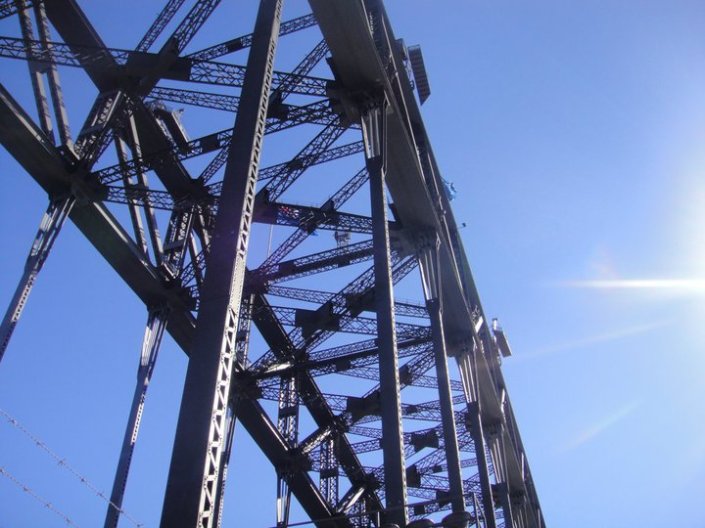
The 9 City Bridge Run was a global endurance challenge where Matt Jones ran nine sub-marathon distances across nine cities in five countries in the space of one month between 4 September and 5 October 2009. The cities were: San Francisco, New York, London, Oxford, Dublin, Tokyo, Alice Springs, Canberra and Sydney. A blog record of the event is at http://www.9citybridgerun.com.
The purpose of the event was to raise awareness of resilience and wellbeing as a counter-point in addressing the combined prevalence and stigma of depression, anxiety and suicide.
A free public forum was held at the Barnett Long Room in Circular Quay, Sydney on 26 October 2009 to culminate the awareness raising effort from the 9 City Bridge Run. The event was captured on video and is available for people to see online.
The symbolism of a bridge was used as a metaphor connecting people, communities, cities and ideas.
This After Action Review is written in the form of a personal reflective think-piece on resilience, connectedness, failure, courage and an industry of fund-raising. These are issues of social leadership affecting how we care for our people and our cities (be that defined with a local or a global perspective is entirely at the discretion of the reader) which should prompt discussions about the efficacy of fundraising and Corporate Social Responsibility programs aimed at affecting social change.
The reluctance of people to confront this issue due to the stigma attached is totally underestimated in our communities.
We need to be more caring in the way we respond to others in our communities, which applies to those we don’t know as much as those who we know as friends, family and work colleagues.
An understanding of resilience and wellbeing should go beyond discrete sponsored programs and initiatives and have a greater impact when developing and shaping policy in any organisation, be that government, business or community group.
Families themselves ought to be places where people can seek support on issues of a difficult nature. Similarly, circles of friendship should take on this burden of responsibility for support that often is not possible to achieve through engagement in families due to strained relationships and tensions.
I argue we should re-examine motivations away from recognition and celebrity to be more based on the concept of ‘servant leadership’ (after Greenleaf) and care for ‘the other’ in the true spirit of philanthropy, mateship and social responsibility.
Bridge building between people is of greater importance than clever marketing campaigns.
How incredibly sad it is that in our society of accessibility today there can be any problem worth killing yourself over at such a young age. The prevalence of this issue is outrageous, and tragically remains muffled by the stigma with which the taboo is accompanied.
A Choice: Failure Or Learning (Chapter 10)
I completed the running phase of the 9 City Bridge Run in Sydney which was the final leg of nine cities. I was exhausted, in every respect. Physically, financially, but mostly emotionally. I had taken some hits, and still knew I hadn’t come anywhere near close to making any impact of importance.
I was stunned at how badly I had executed. Lacking sophistication is part of the journey. It is always tempting to look at the finished product of superstars only to think that they had always been like that. Few people are so good that they never had room for improvement. Trying to define a linear path for any epic endeavour is almost impossible because of the likely and necessary interference from resistance and serendipity. The vision you possess must be robust and resilient, but how you get to your objective will be influenced by factors which at the beginning you cannot know.
Such journeys can be cringeworthy in hindsight because they are so lumpy. The early stages of trying anything are never as polished as when endeavours mature. But don’t forget that even children in their innocence are known for their beauty. So can we agree right now to no longer be embarrassed at the less than glamorous moments during our own growth, but to embrace the journey and all that it brings.
The worst part looking back on the 9 City Bridge Run was the absence of engagement with others compared to what I knew to have been possible. I had travelled across the globe on a mission to address one of the most pressing social issues facing society today, and how deeply had I engaged? I knew people were willing to help, and I knew people cared. But unless they are given a chance to participate, how can they know?
While I was away, I remember speaking with some of my friends who I was working on a volunteer project with back in Sydney. At the end of one of our teleconference we had for that the project, they signed off saying: “have a good vacation!” Even those looking from the outside who I knew reasonably well had no idea of what I was doing. Combined with the disappointing input I had received from the organisation I at first had set out to support, I ended up feeling sheepish about sharing what I was doing. I had started a blog, but didn’t know enough about the interwebs to really know how to share it. In this regard, the journey had began badly and gradually worsened with every day that passed.
At the conclusion of this quest, I had a wealth of knowledge from my reflections and reading along the way that I knew to be worth sharing. But because of the dismal performance of my attempt to create a noteworthy stunt, I felt embarrassed about sharing this. It took me many months until I was able to document my reflections into a discussion paper, and then to share this at a public forum in Sydney.
All of this was essentially my fault. There was no one else to blame.
Take some time to read the After Action Review which I wrote after this experience. It is enclosed as an Annex to the book. Click the hyperlink to read the Executive Summary or the full After Action Review.
There was a public forum in the end, and it was hosted with the help of many people with some great speakers. But what if everything I touched had turned to gold, and the endeavour was a sequence of stage-managed perfection? I believe that is the risk of getting things right. There is value in experiencing the rawness of having to push through. As terrible as the experience was, it has brought me to this point now where I am glad to be sitting in front on the keyboard writing these reflections for you.
At every moment, no matter how bad what came before or the situation you are faced with at that time, we have a choice. Not only do we have a choice, but we are the only people who are able to make that choice. It is our choice. We can make that choice in collaboration or consultation with others, but we must be responsible for our part in that decision.
This is a critically important point. I later came to realise that too many people outsource this responsibility to the weight of cause-related marketing programs. We are suckers for the institution, and the institutions are counting on that being the case. This doesn’t mean that institutions are bad. It just means that we need to remain vigilant and aware of the preciousness of our own autonomy in making up our mind.
The reason this is so important on a personal level is that this is the threshold through which we turn at a signpost in a direction of either growth through learning or defeat through being crushed by failure.
Backswing comes into the equation when we forfeit our responsibility, or we are too embarrassed by what we regard as a worthless performance that we chose not to share our opinions with others.
We need to get over our selves. Failure is part of life, and part of the process for improving.
Reconnecting. The Ripples From Building One Bridge (Chapter 9)
 How can I reconcile such a contradiction that the 9 City Bridge Run was both a journey of misadventure, and at the same time a worthwhile endeavour? I described in the last chapter the difficult nature of the journey, but also alluded to the benefit gained. Sounds incongruent? My explanation might seem to be an effort to salvage some value in what was an nothing more than a ridiculously expensive wasted opportunity, but this is not the case at all.
The idea behind the 9 City Bridge Run grew out of the intention I had for the 7 x 7 City Bridge Run. Both events were underpinned by a journey that was about building bridges.
I instinctively I knew that building bridges was important. But I also was aware that there had to be more substance than a simply reciting a trite slogan. We all know that building bridges between different people is important, but that doesn’t mean that it is something that comes easily. My sense was that the expression “building bridges” is often used as a feel-good sound bite by politicians and business leaders alike. It is also now commonplace as a central slogan for many community activities, and for good reason. Without meaning to sound like a hard-bitten cynic, meaningful action must trump idealism. Words alone are not enough.
What does it mean to build a bridge? We are all familiar with bridges. We cross them every day without so much as a moment’s thought. Every bridge has some basic components: a span extending across one or more supports, which need to be grounded upon a stable foundation. I’m not an engineer, but it seems to me that a bridge consists of these three elements: span, support, foundation. How these three components are designed will depend on the location, the technology available, a sense of aesthetic and ambition by the building team.
A bridge joins up people who were separated, or removes the need to negotiate an obstacle. A bridge might also be a time saving device by creating a path for mobility which bypasses clutter and and competing traffic flows that otherwise might hamper the smooth direction of travel.
Building a bridge can be dangerous. How many times have we read on the news about bridges that collapse resulting in the death of workers?
A bridge can take time to build. It almost certainly requires planning, along also the approval of stakeholders on either side of the bridge and those who will access the bridge itself.
Opening of the bridge is worthy of some form of celebration and acknowledgement. And after the bridge is operational, it needs maintenance.
I embraced the expression building bridges to refer to the conversations that I assumed would inevitably follow from conducting the running stunt. I believed that these would lead to a deeper connection across communities to bring people with resources into the orbit of people who needed their support, or vice versa.
Here, I want to talk about one bridge that was built as a result of the 9 City Bridge Run, which was perhaps the most important bridge that came out of this whole endeavour described in this book. Because of this bridge, all of the hardship, fatigue and expense that I experienced was mitigated. It didn’t make the privation I encountered any easier, but it did mean that it was not a wasted effort. This bridge was never intended to be an objective of this quest, but it has infused it with a sense of purpose.
This ripples created by the building of this particular bridge were significant, and in fact singularly allowed the 10 City Bridge Run to occur. In fact, without this bridge this story would never have been told. It was this bridge alone that ensured this journey was not an entirely redundant waste.
The bridge I am referring to was built between my father and I. The reasons why reconnection was necessary aren’t important for discussion in this book. Suffice to say that we reconnected during the 9 City Bridge Run after a lengthy period of time where there was little contact between each other.
There is a parable told in a famous book about one of two son’s who takes his inheritance from his father while his father is still living. The ancient story brilliantly told in such a way that the context can be understood in any culture. The story sees the son acting with the ultimate disrespect by claiming his inheritance during the lifetime of his father. The son blows all of the money from his inheritance on wine, women and song. He knows that his father is a rich man. He seeks to return to his father and beg for his father to take him into his employment as one of his servants. The son figures that while he would be excommunicated from the family, he would at least be in bearable living conditions. As he approached his father’s estate, his father who had been waiting in anticipation in the hope of his return one day saw the son before he arrived at the estate. It is a wonderful story about reconnecting, and the story goes further to examine the attitudes of other people who are involved in the return of the son into the care of his father. This parable ends by examining the social implications of the son’s return, and beyond that doesn’t continue as a story.
A parable is a parable, and on one level is simply a literary device used to illustrate a point in a given narrative. It well might be a completely fictional story, but is one we as humans can well relate.
The point of the bridge that was built between my father and I is that the ripples continue to extend through both of our lives. The utility of this bridge is extends far beyond the relationship between him and I. Those ripples from the action of building this bridge have also now touched your life, at the very least because you are reading this page. Bridging is an incredibly powerful act, and should never be underestimated. We can’t see the lifetime value of this action at the beginning.
That bridge was built in 2009. Neither my father nor myself knew that at the end of 2015 we would travel together to a place we used to go camping as a family when my brother and I were children. The three of us returned together on this occasion, my father, my brother and I. It was a beautiful day, even though a bittersweet excursion. My father and I were carrying the cremated ashes of my brother who had died during the time I was completing the 10 City Bridge Run. My brother’s last words to me that gave me the necessary inspiration to continue this running journey until completion. But none of that would have mattered if my father and I weren’t on talking terms because of the absence of a bridge.
A Tale Of 9 Cities (Chapter 8)

Looking back now, I can see the idea behind the 9 City Bridge Run was brilliant, but while it might have been brilliant, the execution was terrible.
Let me rephrase that: the intention was sound, but with an absence of supporting strategy. Of course, I knew I needed promotion, I knew I needed to connect with an engaged community, I knew I needed a channel for communication across the appropriate medium, and I also knew I needed a tangible means of engagement by others who wanted to get involved. And while I knew all of this, how much of this did I execute well, if at all? If I can be completely honest in my appraisal of my performance, I would have scored highly for the intention, and maybe with a few additional points added for encouragement, but a big fat zero would be awarded for execution.
This book is more than a narrative of my travel journal. The methodology is to use active learning to highlight a concept I have called Backswing. I undertook an endeavour, which even though it has been underway for several years remains incomplete and a work in progress. Enough distance has been travelled for me now to have a sense of perspective of how to learn from what took place. A lot happens inside the space of a decade, and my aim is not to include every event within these 100 chapters, but rather to construct a framework through which I can help you identify, explore, understand and embrace this concept of Backswing.
If you are reading this on my blog, it is likely that this sentence will be removed before this is published as a book at the end of June 2016. The purpose of pushing out these chapters as blog posts is to solicit feedback and invite your participation in the creation of this book. I expect that 50 or 60 of the chapters will be published by the end of May at which time the entire book will have been completed in draft. My intention is to self-publish the book in New York at an independent bookstore in the Lower East Side of New York where they have a publishing machine inside the store. I’m guessing I will do an initial run of a limited number of copies, and then look to republish.
What is worth noting is that my sense of execution now is considerably more evolved that what it was in 2009. It is not as though in 2009 I was an idiot with no experience of planning or execution. I had a wealth of experience by then from a previous life as an Australian Army Officer. For a range of reasons, some personal and many completely unrelated to the endeavour itself, the level of difficulty had been raised to a difficulty which I was not completely prepared. That is life. Often, things are not exactly as we would like them to be, but there is little choice except to crack on.
These first 30 chapters will set a construct for understanding Backswing as a concept. This will be examined with a little more scrutiny in the following 30 chapters in terms of how it was specifically applied to the journey that became known as the 10 City Bridge Run. The next 30 chapters will deconstruct the Backswing concept more fully as a practitioners guide, and with the final ten chapters summarising what Backswing means for us as a concept.
I made plenty of mistakes along the way of this journey. It was always motivated with the best of intentions, and as you can read in the earlier chapters, it was done responding to the hardship experienced by others. Some of the decisions I made were laced with stupidity. Self-funding the entire journey for the 9 City Bridge Run was perhaps one of those decisions.
“Was it worth it?” One perspective would be that it was a complete waste of time and money, however that would not be entirely true. Even mistakes have their value. They might not be pretty, but there is value if we are able to learn from them. The question is how much cost can we bear before the value is diminished by unacceptable losses that we can’t recover from. The fact that I am writing this book and looking to the future with a sense of determination to make change happen indicates to me that the journey has been worthwhile.
For all of the feelings of inadequacy I might have had during the journey, this was outweighed by the enormous sense of enjoyment that was entirely liberating when running. This liberating sensation kicked in easily within the first 100 metres of beginning the first leg of the 9 City Bridge Run in San Francisco, and was mirrored by a feeling of accomplishment when wrapping up the last leg of the 10 City Bridge Run in New York many years later. On the balance, it was a painful and unpleasant experience, but worthwhile in spite of all the gnarly struggle I encountered.
I am going to come back to this chapter and edit it with more relevant experiences from the 9 City Bridge Run that saw me travel through San Francisco, New York, London, Oxford, Dublin, Tokyo, Canberra, Alice Springs and finally Sydney. It is not a travel diary, but for the purposes of this blog I had to get the reflection which I wrote above off my chest before I can better document this experience.
This Tale of 9 Cities was a mixed bag. There were good, intriguing and otherwise downright frustrating experiences along the way. I still have a lot of video footage from those times, particularly some of the interviews in Oxford which contain priceless reflections to transcribe. At the time, I didn’t appreciate the value of the words people had spoken.
I found great expressions of support along the way. For example, in New York the Australian Embassy was incredibly supportive, but it was almost impossible for people to understand where the idea of the journey would land by most people, myself included. This impacted on how people were able to engage, and I am largely responsible for not being clear enough in my intention to open the door more to the participation of others.
But here is the question: was it a journey of missed opportunities, or a necessary quest in order to get to this point of knowing what an epic journey entails?
Ironically, if I had encountered success in 2009, I might have been cheated of this opportunity to explore the concept of questing and Backswing in greater detail. It is a useless hypothetical, but it is interesting to consider what might have resulted if I had been outrageously successful in my efforts back in 2009.
The trip to Dublin was probably a low point. I went there specifically because the organisation I have mentioned earlier that I commenced the journey to support had recently opened an office there. I have no idea if their operations there are still active, and to some degree that is immaterial. What is worth reflecting on is the unfortunate dependency of not for profit organisations on fundraising. Fundraising too often becomes an outcome in itself at the expense of a focus on impact that matters.
I travelled to Dublin from London, and had booked on RyanAir which was the cheapest carrier. I missed my flight to the airport by a minute because of some transport issues. Except for the fact that I was footing the bill for the entire endeavour, it wouldn’t have annoyed me so much. If I was just on some holiday adventure I probably would have been more prepared to roll with the punches. What really annoyed me was the same lack of concern from the staff team in Dublin as I had encountered in San Francisco from the organisation I was seeking to support. It seemed apparent that they could care less if I arrived or not. Missing the plane meant having to return to London for the night and attempt the arrive the next morning when I would run the same day I travelled only to return to London on the budget airfare the same day. I had intended to travel that evening to stay fresh for the run ahead, but instead arrived in a pretty tired condition.
Arriving in Dublin, I wasn’t really surprised to learn no one had offered to greet me at the airport. I found my way to the office, feeling unwelcome in a city I was only visiting because of my feeling of duty to support the organisation I had partnered with in Sydney. When I found their office, the staff couldn’t have been less interested that I was in town to see them. The staff were all Australian, and ironically focused on mental wellbeing. It was a classic example of the institution being All Backwing. A massive “No Hit” that ranked right up there with the many missed balls I encountered along that journey. The saving grace was that another Australian friend of a friend was also working in the same building but with a different organisation and had read the situation well enough to know that sitting down with my for a short conversation was something of value he could provide.
Dublin was full of treasures, and I encountered the Chester Beatty Museum that to this day remains perhaps among the finest collection of classical art I have seen in the world. But this was mixed with a horrible sense of loneliness. I felt as though I had no right to express this feeling of loneliness because I doubted people would understand why I was undertaking such a ridiculous and ill-conceived excursion.
The point of the 9 City Bridge Run was to use running as a stunt to raise awareness of wellbeing as a counterpoint to depression and suicide. While I had some meaningful conversations along the way, it was my own reflections on a personal level that made this worthwhile. I learnt a lot even if no one else was listening.
Returning to London, I encountered a profound conversation with a complete stranger not associated with my efforts. He was a taxi driver who listened as I explained what I was doing in London and spoke about my aspiration for the run. He was very moved, and reflected on the importance of this journey as if that one conversation was the singular qualifying response that compensated for the lack of engagement with pretty much everyone else. He was an ordinary Londoner, but his gesture was remarkable. The taxi fare was five quid, and as I went to pay he refused to take my money it saying that he would make up the fare from his own purse. More than that, he pulled a five quid note from his pocket and offered it to me in the hope that somehow it would make a difference. He insisted that I take the note which I still have in my possession to this day. He was right. It did make a difference.
This book is ultimately about making a difference through creating change. Backswing is not a binary concept, and it needs to be considered in many dimensions. Small gestures of kindness like that shown to me by the taxi driver have an asymmetrical impact, and in themselves are the antithesis of Backswing. The point is though that small gestures of kindness on their own are not enough. Similarly, the impact of the institution can create a dynamic sense of synergy with exponential influence, but where Backswing is present can dull any momentum and kill of hope and dreams.
The homeward leg of the 9 City Bridge Run was a lap around Sydney Harbour, in fact the same route which my mean-spirited nemesis had sought to deny me back in 2007. I had run that route literally dozens of times in training, and I knew every turn and almost every tree and rock intimately. Even though it was familiar, this time it was different. Standing outside of Sydney Town Hall before commencing the journey, I felt incredibly pathetic because I sensed I had made almost zero impact through my efforts. All I had were stories of hardship and missed flights. The city was busy, with buses and people darting up and down George Street, but it seemed that no one was listening.
No one was listening. I imagine that would be a crushing feeling for people standing on the precipice of suicide, their conviction of a life which amounted to complete futility. Moments later, a decision and then their precious life would be extinguished. I believe that this is the tragedy of suicide: we live in a world with no shortage of problems, and the greatest wasted resource is the connection we have with each other. It was as though I had to go through this god-awful tribulation to fully understand what that felt like.
Running down the worn goat track woven through the fern-covered banks of Sydney Harbour somewhere between Waverton and Wollstonecraft I heard the tranquil dribble of the spring which gurgles a slow stream of water in the cool of this hidden nursery. It was a moment in time to remind myself that in spite of everything, beauty could be found anywhere. I was happy in the moment that I was alone, concealed by nature, and protected from the unseeing eyes of the maddening crowd who otherwise would have crucified my morale on those last few kilometres of a global journey.
We don’t know the consequences of our actions. Much like the taxi driver in London, I don’t know what his story was or how his life might have been changed by the opportunity to offer me his graceful act of generosity. If we do feel we are caught up in Backswing, sometimes it is worth noting that there is a bigger picture we can’t see at that moment. Seek improvement always, but never abandon hope either.
And so this was an experience of disenchantment. I wrote a reflective paper about my experiences, and that perhaps best summarises my experience. It is enclosed an an annex to this book (included with the next chapter for the purposes of this blog).
There was an overarching context to this Tale of 9 Cities which is not mentioned in my notes written above. It was during this misadventure that my struggle across the next five or six years really began. In no small way do I attribute my ability to grasp the idea that enabled me to undertake the 9 City Bridge Run was from the fruits I experienced as a participant in the Vincent Fairfax Fellowship. What might seem like Backswing in a given moment will later be realised as a necessary event towards what is necessary for you to do.
The Tale of 9 Cities was about plumbing the depths of failure. At the beginning of that year I rejected an offer to rejoin the army that was made from a very senior figure within Australian society. Backing yourself takes guts and brings with it unwanted and unintended consequences, and in this case it meant slipping into an extended winter of financial hardship.
Naivety and Disenchantment (Chapter 7)
 Prior to departing Australia, I had approached an organisation which was branded as a leader in helping to combat suicide. They had a good public face and all of the statistics to match. I wanted to ground my efforts for the 9 City Bridge Run in supporting an existing organisation that was capable of delivering change. I wanted my efforts to amount to something. I was inspired to be part of their team, and with that sense of imprimatur which I received from their approval to raise funds for their newly international expansion into the domain of suicide prevention I set off to San Francisco where I would commence the running stunt at the completion of a conference I was scheduled to attend.
The concept for the 9 City Bridge Run was simple enough: I proposed to run 9 ‘sub-marathons’ in 9 cities across 5 countries. There was no particular distance specified, but I did intend to complete the journey all inside of one month. The number 9 was chosen simply because it was 2009. I intended to commence in San Francisco as the first city, then head to New York, London, Oxford, Dublin, Tokyo, Alice Springs, Canberra and finally Sydney. The plan was that I would undertake the running, and this would create some attention that hopefully would lead people to donate money to the organisation I was supported. Perhaps naively, I had agreed to pay all costs myself, and there was no offer of support or offsetting any expenses from the organisation I was assisting.
I can’t exactly remember arriving in San Francisco. I had gone purposefully to attend the second SOCAP conference, the first of which I had attended the year before in 2008. I had become part of this fledgling community, consisting of people who were bringing their ideas and dreams to the attention of others. Kevin Jones was the convenor of this conference, exemplar for sharing and collaboration.
I admit to feeling a little nervous on this occasion, not because I was attending the conference but because I was about to embark on a journey which I had no idea where it would take me. I felt completely overwhelmed by what lay ahead, and this was reflected in my preparation. The journey was much bigger than me, and even though I recognised it was a big undertaking, I still at that point had no real comprehension of the epic nature of what I was about to commence. Maybe it was my feelings of anxiety that led me to downplay what I was about to start in the days that followed. It was easier to avoid the issue than to take responsibility for my own sense of embarrassment that I was about to dive into waters far too deep for my ability. And so the stage was set for what I refer to as Backswing.
Self-censoring is an atrocious waste of our innate potential if done in avoidance of an irrational embarrassment. This is the ultimate in Not Hitting, being All Backswing. It is self-sabotage in its simplest form, responding to excruciatingly useless fears of our inadequacy. It is the worst form of excuse for taking no action.
At the conference, I spoke to many friends who in the recent years I had adopted as mentors through observing their actions. Among them were some of the world’s most respected thought leaders. They had accomplished much, and I was always struck by their humility and kindness. I was bashful when describing the activity which awaited me at the end of the conference. More than likely, none of them knew what I was preparing. I was caught in a vicious cycle of Backswing. The more I gave counsel to my fears, the more I was daunted by my own sense of inadequacy, and this led me to avoid talking about that which lay ahead, which in turn fuelled a preparedness that was destined or designed to fail. Backswing thrives on the absence or dulling of momentum. Much like releasing the spring-loaded bolt which has been wound up for impressive performance, overcoming Backswing is relatively easy if the right impediments are first removed. But first the question must be answered: “so, what’s holding you back?”
I spoke to my friend Martin who years earlier had established an innovative business that provided clean water to farmers in areas of extreme poverty through the deployment of treadle pumps. Martin was widely recognised globally as one of the leading lights among social entrepreneurs whose example had helped shape a nascent army of change makers, a vanguard that was launching an unbridled assault on injustice, poverty and waste. He was characteristic of this group, and a great listener with huge capacity for quickly analysing problems.
Martin asked what I was up to, and I mumbled something about the 9 City Bridge Run. I know it sounds astounding, but he was probably one of the first people outside of Australia that I spoke to with some sense of clarity about that endeavour, even if I was playing the role of a reluctant salesman.
I think Martin was amused at what I had to say, and responded with a hint of mischief as he asked if I was going to post information on the noticeboard inside the conference area. I remember asking him in response if he thought his would be allowed. He laughed quietly to himself and I think answered with a question: “when was permission ever the pre-requisite for taking action?”
While I did have a badly designed piece of collateral to support this initiative, I don’t think I did place anything on the noticeboard. I remember listening to what other people were doing and thinking of all the reasons why what I was doing was a dumb idea. The bottom line is that unless we have confidence in our own endeavours, there is no reason why anyone else should too. There are times in a journey when the going gets tough, and you need the support of others around you to keep you moving forward. That is completely different to forfeiting to others our responsibility for having the requisite belief in our undertakings, and hoping that they might carry us along. Backswing creeps in when we seek the licence to operate from others rather than having an unshakable belief in our own ability to achieve our goals. That unshakable belief also needs to be tempered with huge self-awareness- we neither need to be blind to what are prudent limitations.
Half-baked is different to being held back by Backswing. Half-baked is a starting point, maybe not a good one, but a place to iterate from through a series of prototypes and evolutions so as to improve to a highly refined outcome. The problem comes when self-criticism prevents actions that lead towards failure which is a necessary step towards improvement.
It was curious that at this point in time, I had never thought to ask why the organisation I was supporting hadn’t offered to provide any collateral in the form of flyers, posters or even a website or blog. I assumed naively that this was my responsibility. I did receive t-shirts from the organisation to run in. They weren’t athletic shirts, but at that point that alarm bells should have been ringing in my head.
I wanted to begin and end the first run with some sort of noteworthy manner, and thought that it might be reasonable that the representative who the organisation had recently recruited in San Francisco would want to get involved somehow. There was no interest shown from the fundraising team back in Sydney to meaningfully help, and it was left entirely up to me to management how their brand was presented.
I asked their representative in San Francisco if her would join me for a pre-run gathering, and whether he might be able to pull together some media attention.He was entirely reluctant to get involved, which I thought was weird, after all it was I who was funding the cost and I who was about to make the effort. The least they could do would be to wave the flag a little bit, surely?
After much hassling, he agreed to join me before the run. The meeting turned out to be a ridiculous pantomime with him asking me to pose for the camera which revealed the shallowness of his understanding of the task I was about to undertake or for that matter how this stunt might affect the work of his organisation.
It was during this engagement that it dawned on me that I had partnered with the wrong organisation. What could I do? Back out? Not run? If I did, what would that have said about my resolve to represent my friends who had tragically died. I was committed, and knew that I was about to foolishly embark on an journey of epic proportions.
A journey of epic proportions. It was surely going to result in a colossal folly at work but with the potential for monumental impact at best, and perhaps both simultaneously.
I felt deflated before the journey had actually begun, and decided there that my involvement would be better focused towards raising awareness as best I could rather than being focused on fundraising. This experience reinforced my cynicism of the charity model which I began to identify as broken. That in itself is a form of Backswing on an institutional level.
Drawing on my army training, I knew that the only way to resolve a difficult situation like this was to go through it. And so that was how the 9 City Bridge Run began.
 Building Bridges