Month: October 2010
20 Days to Go: Why the G20?
The G20 Summit in Seoul commences on 11 November. So too does the 10 City Bridge Run.
But why the G20? Isn’t that only about banking and a talk-fest among world leaders?
The 10 City Bridge Run forms a bridge conceptually between the United Nations Millennium Development Goals (in particular MDG 4: Reduce by two thirds, between 1990 and 2015, the under-five mortality rate) and the leadership of the 20 largest economies (19 countries plus the European Union).
This is what the G20 agreed upon following the last meeting held in Toronto in June this year under the heading of ‘Development’:
We recognize that 2010 marks an important year for development issues. The September 2010 Millennium Development Goals (MDG) High Level Plenary will be a crucial opportunity to reaffirm the global development agenda and global partnership, to agree on actions for all to achieve the MDGs by 2015, and to reaffirm our respective commitments to assist the poorest countries.
In this regard it is important to work with Least Developed Countries (LDCs) to make them active participants in and beneficiaries of the global economic system. Accordingly we thank Turkey for its decision to host the 4th United Nations Conference on the LDCs in June 2011.
Narrowing the development gap and reducing poverty are integral to our broader objective of achieving strong, sustainable and balanced growth and ensuring a more robust and resilient global economy for all. In this regard, we agree to establish a Working Group on Development and mandate it to elaborate, consistent with the G-20’s focus on measures to promote economic growth and resilience, a development agenda and multi-year action plans to be adopted at the Seoul Summit.
The website foe the Working Group opens a blank page. I want that to change.
The methodology used by the 10 City Bridge Run is about raising awareness of an individual’s capacity to act to influence extreme poverty. It involves:
- Observing
- Listening
- Bridge building
- Petitioning
- Doing
- Asking institutions what action they took after making public statements
- Learning
Join me on this journey. It is not a spectator sport.
Heart of Darkness: G20 Protests

Searching ‘G20‘ on YouTube I was amazed to see almost every link that comes up was of confrontation between protestors and police.
Of course, the range of issues the G20 discuss is broad. It is not only about extreme poverty. That is only a small part of the summit agenda.
Do the protesters at the G20 present a credible alternative?
Watch the video clip here of Toronto:
Or this one from London:
21 Days To Go: 8 MDG. MDG 7- Environmental Sustainability

Working toward the start of the G20 Summit in Seoul when I will set of with the first steps of the 10 City Bridge Run. 240 km ahead of me across 10 cities in 10 countries within the space of one month.
Previously on this blog I looked at Millennium Development Goals (MDG) 1 through 6, and then made a summary of what looks to be a massive deficit in achieving this seemingly impossible objective. Can it be done, and does it matter?
I was fortunate to attend a City of Sydney presentation on the MDG last week which gave good insights to understanding the MDG in perspective which I made mention of in this blog post.
Continuing this list of MDG, today I turn to MDG 7: Ensuring Environmental Sustainability. This is one MDG which is not looking like being addressed successfully. It covers many broad areas that are affected by bigger sustainability issues.
This MDG has four targets:
- Integrate the principles of sustainable development into country policies and programmes and reverse the loss of environmental resources
- Reduce biodiversity loss, achieving, by 2010, a significant reduction in the rate of loss
- Halve, by 2015, the proportion of the population without sustainable access to safe drinking water and basic sanitation
- By 2020, to have achieved a significant improvement in the lives of at least 100 million slum dwellers
Here are comments from the United Nations on progress and challenges:
- The rate of deforestation shows signs of decreasing, but is still alarmingly high
- A decisive response to climate change is urgently needed
- The world has missed the 2010 target for biodiversity conservation, with potentially grave consequences
- Key habitats for threatened species are not being adequately protected
- The number of species facing extinction is growing by the day, especially in developing countries
- Overexploitation of global fisheries has stabilized, but steep challenges remain to ensure their sustainability
- Safe water supply remains a challenge in many parts of the world
- With half the population of developing regions without sanitation, the 2015 target appears to be out of reach
- Disparities in urban and rural sanitation coverage remain daunting
- Improvements in sanitation are bypassing the poor
- Slum improvements, though considerable, are failing to keep pace with the growing ranks of the urban poor
- Slum prevalence remains high in sub-Saharan Africa and increases in countries affected by conflict
Is it just me, or does it astound you too due to the following statistics. How can it be that in our world of technology, convenience and accessible luxury that this should be the case? Go figure! Next time you get delayed standing waiting for your skim-soy-decaf-latte, count yourself lucky and enjoy the privilege of knowing at the end of the queue is anything you care to order:
- 2.6 billion people lack access to basic sanitation services, such as toilets or latrines.
- The world has missed the 2010 target for biodiversity conservation. Based on current trends, the loss of species will continue throughout this century.
- Slum improvements are failing to keep pace with the growing number of urban poor. The absolute number of slum dwellers keeps rising.
A Different Perspective

Yesterday I posted a blog titled: Did the Government Let Us Down? where I questioned claims that had been made that not enough had been given by own government toward the Global Fund which contributes towards the eradication of diseases: in particular HIV/AIDS, malaria, TB.
I was asking: how much money is ‘enough’?
Outcomes from the United Nations Donor Meeting held on 4-5 October sparked this discussion. The meeting announced that US$11.7 billion had been pledged in new funding over the next three years to support the Global Fund to Fight AIDS, Tuberculosis and Malaria. This in fact represents the largest-ever pledge for the collective effort to fight the three pandemics and will allow the Global Fund to further support countries as they work to meet the Millennium Development Goals (MDG) related to health.
United Nations Secretary-General Ban Ki-moon commented in a more positive manner from the earlier claims which promoted my blog yesterday. He said:
At a time when so many Governments are tightening their belts at home, these commitments send a powerful message: It shows how seriously world leaders want to do the right thing beyond their borders, too.
What can we make of this? Two different claims, with the United Nations Secretary-General applauding this initiative. The esteemed members of the MDG Advocacy Group have shown support for what they describe as “the ample replenishment of the Global Fund”. The MDG Advocacy Group summarised it like this:
We can recommend no better and more timely investment on the planet to support the Millennium Development Goals.
That sounds like a call-to-action to build bridges with all the time we have available between now and 2015. 21 days to go before I start running (no more false starts!). Please step up and do what you can to influence extreme poverty. You might support this initiative with a $24 sponsorship, or from the time I commence running submit a photograph of a human bridge to be presented as a pictorial petition.
Any other ideas worth sharing? Let’s hear them!
You have to fail in order to move forward

Walking back from training this morning I struck up a conversation with Lee. Lee was walking ahead of me and looked a little unsteady on her feet so I asked her if she was alright. It turns out she had broken her back and spine a few years back, but through determination and persistence she was not only now walking again but also looking forward to again returning to her previous enjoyment of sprinting. Inspirational.
I was inspired by her story. The long journey of overcoming a disastrous turn of events, and the slow and gradual road to recovery. Achieving things which she was told she would never do again- standing, walking, independence- things we all take for granted.
She mentioned a quote from Arnold Schwarzenegger, which although not verbatim, is something like:
You have to fail in order to move forward.
Not everything goes to plan, and setbacks should just make you more determined to succeed. Being comfortable marked the beginning of the road to mediocrity. Listening to her story, it dawned on me that the level of discomfort and pain she had endured- physically and emotionally- would have been intense at different times.
I mentioned some minor discomfort with my left calf calf muscle in comparison to what she had overcome indicating that her story had put my injury into perspective. She listened and then suggested that maybe this irritation might be linked to my big toe. She suggested some stretching exercises, incorporation of swimming (for hip mobility), talked about diet and a list of awesome advice which was great to receive.
Lee gave me some insights to improving my training and conditioning- about excelling performance and avoiding overtraining. We finished with her giving me her philosophy to attitude and goal setting. A great start to the day. Thanks Lee.
Powered by Brooks
Thanks to Brooks and the Sydney Running Centre for sponsoring a pair of Brooks Beast running shoes.
Every contribution makes a big difference, and for a running event, shoes are an extra special concern of mine.
I was delighted when Phil from the Sydney Running Centre called me with the good news of sponsorship from Brooks. The Brooks Beast is a great running shoe. It has good stability, and comes in different width sizes (most shoes don’t) so it gives me the extra room needed in a 4E.
This morning I took the shoes out for their first training run, with some light sprint training, and over the next few days will slowly increase the distance to break them in.
Thanks to Phil at the Sydney Running Centre and all the crew at Brooks.
Is it worth making a profound difference in a small pond?

Is it worth making a profound difference in a small pond?
Did the Government Let Us Down?

Tom Bland from Oaktree made this comment last week:
Last week, Kevin Rudd committed $210 million of Australian money towards the Global Fund to fight HIV/AIDS, TB and Malaria. The global community coughed up a total of $11.7 billion.
Let’s not make excuses, or pretend that this is enough money – the reality is that it’s simply not good enough. The Global Fund needed $13 billion to even keep doing what it’s already doing. It needed $17 billion if it was to meet future needs, and $20 billion if it was to adequately help achieve the MDGs and end mother-child transmission of HIV. Australia’s fair share was $500 million – and we didn’t even get half that.
I wonder how Australia made that calculation- the $210 dollars? I wonder whether Australia actually have a ‘fair share’ to contribute?
When is the point reached where ‘enough money’ is given? Who decides? And if the Australian Government did fall short, who did they let down- us, the United Nations, those who have yet to be infected with HIV/AIDS. TB, Malaria or Measles?
Why didn’t the Global Fund just cut out the inevitable disappointment from government and lean on a few ‘rich’ people, as Peter Singer suggests in his book The Life You Can Save?
And if we are all surprised at the government giving less than half of what their ‘fare share’ ought to have been, what the hell was going on in New York during the high-level conference about the Millennium Development Goals which was addressed by Kevin Rudd and monitored in New York by Oaktree?
Who was to blame for the other $6.3 billion deficit where the Global Fund fell short? Fair shake of the sauce bottle!
I think there is more to this than complaining over a ‘fair share’ of money being paid to the Global Fund. What was achieved at the United Nations Conference in September? Is this report from Tom Bland the first signs of blame toward government and the United Nations as we approach 2015?
How should we now respond? Giving money to make up the shortfall?
Training Log 17 October: 15 km City Loop and Harbour Run
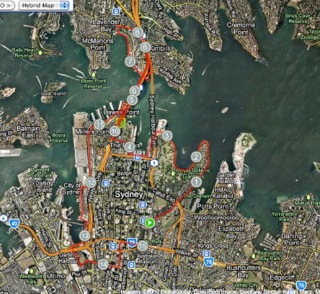
Took off on an relaxed pace for a harbour run around the Botanic Gardens to Opera House, crossing the Harbour Bridge down to Lavender Bay.
Passing Luna Park and up the stairs that lead to the small Indian Restaurant (if you know North Sydney, you will know which one), then back across the bridge exiting off to where Hickson Road goes under the bridge.
Taking Hickson Road to King Street Wharf, then down to the end of Darling Harbour, and back to Hyde Park via Liverpool St and Pitt St.
Perfect conditions for running, and a good course with mostly flat, many pedestrians in parts and some good bends and sights.
Absurdity of Focusing on Outputs- Does Aid Matter?

Injustice and oppression is at the heart of poverty. Ultimately, collective action and social activism is key to making a difference rather than billions of dollars of money.
This would be a summary that I would make from attending the City of Sydney event last night focusing on the Millennium Development Goals (MDG). Three excellent speakers presented thoughtful and engaging addresses followed by a short time of question and answer.
The speakers were:
- Prof. Stuart Rees, Director Sydney Peace Foundation
- Steve Killelea, Founder Global Peace Index
- Mark McPeak, Director Childfund Australia
There was a general consensus of the reality that the MDG won’t be met by 2015. These were aspirational goals from the outset in 2000. Nobody really expected success, and progress that has been achieved should be celebrated.
Good points were made:
- MDG have proved a good tool for cooperation and focus
- Success in the MDG is influenced by the bias in figures resulting in progress in India and China
One concern is the degree to which money that has been pledged hasn’t been received. Of the US$25 billion pledged to Africa from the G8 Countries, only 40% has been received. Who then do we blame for lack of progress in Africa, for the best of death that extended across sub-Saharan Africa? I don’t think it is as easy as to say: “It is the fault of the rich countries. They all should have given more.” Would that really have solved the problem?
The problem in this respect really is the grand statements that are made by political leaderships of such countries followed by no delivery of the money to back it up.
Consider this figure cited: that the fiscal stimulus over the last 18 months given to banks exceeds the total amount of aid given to Africa ever. Fair? Reasonable? Complex.
Mark McPeak raised an interesting point about the absurdity of focusing on outputs. Using the example of solving hunger, he argued that if on 1 January 2015 every food vender made sandwiches on that day and we then distributed them globally, we would have ‘solved’ hunger…. Yes, but for how long.
Hunger. There are other needs we all need than just the next meal. The next meal is important, but there is more needs to life than are measured by such outcomes.
Stuart Rees made a good point that when organisations had little money from grants and aid, people would cooperate like mad. Now with so much competition for funding, brand and messaging have become all important. Time to step back from the commodification of ‘doing good’.
The evening ended on a positive note. This is a contested space. It is up to us to fix it. There will be more problems and challenges to face in the future. Let’s start by developing a better understanding the ‘other’ which is an essential step of making the world a better place for all.
Please support this through sponsoring the 10 City Bridge Run for $24.
 Building Bridges