Millennium Development Goals
8 Days to Go: 8 MDG. MDG 1- Eradicate Extreme Poverty and Hunger

Eight days to go until the first run on 14 October commencing the 10 City Bridge Run!
I thought it might be timely to revisit the Millennium Development Goals and try to shed some light on where progress is occurring. More importantly, also examine where the shortfall might occur on 2015.
Millennium Develop Goal 1: Eradicate Extreme Poverty and Hunger
There are three targets under this goal:
- Halve, between 1990 and 2015, the proportion of people whose income is less than $1 a day
- Achieve full and productive employment and decent work for all, including women and young people
- Halve, between 1990 and 2015, the proportion of people who suffer from hunger
Conflict and the global financial crisis is cited as the reason for a disappointing backsliding in some of the progress last decade. Some comments from the United Nations of progress are:
- The global economic crisis has slowed progress, but the world is still on track to meet the poverty reduction target
- Prior to the crisis, the depth of poverty had diminished in almost every region
- Deterioration of the labour market, triggered by the economic crisis, has resulted in a decline in employment
- As jobs were lost, more workers have been forced into vulnerable employment
- Since the economic crisis, more workers find themselves and their families living in extreme poverty
- Hunger may have spiked in 2009, one of the many dire consequences of the global food and financial crises
- Progress to end hunger has been stymied in most regions
- Despite some progress, one in four children in the developing world are still underweight
- Children in rural areas are nearly twice as likely to be underweight as those in urban areas
- In some regions, the prevalence of underweight children is dramatically higher among the poor
- Over 42 million people have been uprooted by conflict or persecution
The Three Most Significant Notes on MDG from Obama at UNNY
Put simply, the United States is changing the way we do business… For too long, we’ve measured our efforts by the dollars we spent and the food and medicines we delivered. But aid alone is not development… Instead of just managing poverty, we have to offer nations and peoples a path out of poverty.
Speaking from New York at the United Nations Summit on the Millennium Development Goals on 22 September, President Obama gave emphasis to a number of points in relation to the eradication of extreme poverty. Here is one opinion from an observer. For me three points stood out that should grab our attention:
- If we continue to keep on the same trajectory we won’t succeed and achieve the Millennium Development Goals (by 2015)
- To developing countries (read the G20 members): Resolve to put an end to hollow promises that are not kept. Focus not on money but on results.
- No one nation can do everything and do it everywhere. Just as this work cannot be done by one government, division of labor among a wide array of stakeholders is crucial.
What can we expect in 2015? Is this hope we can believe in?
Is the seemingly impossible possible?
New York- UN MDG Summit Offers Hope
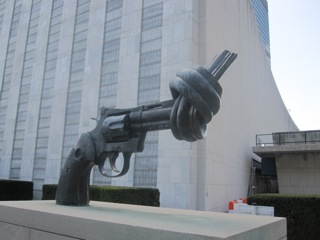
This week in New York, a United Nations Millennium Development Goals Summit is underway.
10 years after the Millennium Development Goals were first announced, this is an opportunity for the world leaders of 150 countries to come together and review progress.
Australia is represented by our Foreign Minister, Kevin Rudd.
What can we expect from this conference? The news bulletins have rung with the sounds of billions of dollars expenditure, and initiatives for improving education, health and eradicating poverty. What happens once the bureaucrats and politicians have finished on Wednesday? Is it really that easy to solve extreme poverty?
Translating the media spin into meaningful action is important. But it is good this Summit is being received with such optimism offering a hopeful future. A big change from Copenhagen.
See what AusAID, Australia’s Aid Program had to say here.
Please support the 10 City Bridge Run to highlight small actions which will make a big difference in showing that the impossible can be possible. Please sponsor me with $24 here.
Pause and reflection: musical interlude on 9/11

This morning we launched the 10 City Bridge Run with a spirited gang of runners and walkers rejoicing in glorious Spring weather to cross the Sydney Harbour Bridge to Milsons Point. Photos and more details later this evening.
Today is also the 9th anniversary of 9/11. What a decade! Some writing over the past nine years has spoken about the importance of eradication of extreme poverty because of the strategic gain it presents in the so-called ‘War Against Terrorism’. While this might be a desirable indirect consequence, our efforts to eradicate extreme poverty should have the aim of ending needless suffering so unevenly distributed across the world.
Here is a musical interlude from The Black Eyed Peas reminding us that too many Bridge Builders is never enough. The is still much more work for all of us to do.
Its time to change the narrative, and a positive outcome is truly within our reach. The Millennium Development Goals provide a useful framework through which to work toward the eradication of extreme poverty. The journey ahead over the next 42 days for me is as much a process of learning and inquiry- I don’t have the answers, let alone a few comprehension of the issue in its entirety.
Please join me in learning more about the issue of extreme poverty and what is actionable to make a meaningful difference through our own actions.
Counting down (to 2015)

Check out the link to the Countdown to 2015 initiative I received sent through from my mate Stephen Mayers here in Sydney.
Another example of some of the great work and focus people are bringing to the urgency required to address the achievement of the Millennium Development Goals.
A summary might be that there are many reasons to be optimistic about progress toward achievement of the Millennium Development Goals, however the progress has been unevenly distributed. It is time to seriously focus on a countdown toward the time horizon set to achieve these goals of 2015.
Take some time to click through this site and watch the embedded video. What is your response?
Inspiration…why do this to yourself?!

What has most shaped me to want to commit to the 10 City Bridge Run?
The idea for the 10 City Bridge Run was thought of and developed by myself (Matt Jones). My experience running a similar event called the 9 City Bridge Run last year left me with a sense of responsibility from the lessons I learnt to do something meaningful with that knowledge in 2010 which over time emerged into the 10 City Bridge Run.
My outlook in relation to this project has been largely influenced by my experience through my previous extensive service as an Australian Army Officer. This is broad and includes encounters with ‘unseen’ neglected and dilapidated Indigenous communities in Central Australia during the late 1980‘s, and later deployment on Active Service in East Timor seeing the often wasted efforts of a number of inefficient charity projects aside good examples of well run government and charity interventions.
Additionally later responsibilities as Desk Officer standing up and managing Australian Army response to the 2004 Aceh Tsunami relief effort showed the incredible power of media and the ‘fund raising industry’ to reap focused attention and financial contributions globally. The level of accountability following such efforts is often overlooked, along with less glamorous, unaddressed, longer-term, systemic issues which fail to have the capacity to ‘sell’ themselves. In these circumstances I witnessed the awesome efficiency by which the corporate machine is able to mobilise brand, but sadly often with disturbingly very little real impact on the ground to boast about other than a handful of photographs and well conducted fund raising efforts.
While this might seem overly critical, having worked in support of the United Nations in different capacities while serving in the Army I am concerned about the likely outcome of the Millennium Development Goals (MDG) due to be reported on in 2015.
Jeffrey Sachs in his book The End of Poverty paints a picture where the eradication of extreme poverty might be possible to achieve by 2025, which is to some degree based on the successful achievement of the MDG in 2015.
Can we be sure that the necessary attention can be maintained by countries and institutions to achieve this? The influence of the global financial crisis is likely to be disruptive, and the outcome of Copenhagen last year was not a promising indicator.
Meanwhile, every day children continue to suffer and die as a result of the conditions of extreme poverty they are borne into. What can we do to change this?
Is giving more money enough? Should we start up more ‘not for profit’ organisations with a focus to eradicate poverty? Should we turn our backs on the situation? What will it take to move action forward on the MDG? Will a conference of leaders in New York this September cut it?
I recently conducted in person an informal survey of contacts I met across five countries between March and May this year. I was surprised that most people had never heard of these MDG. Even so, every person I spoke with was fully engaged when presented with the statistics on child mortality.
I contend that action needs to come from the global community, with people acting as bridge builders. What might this look like? I am not sure, but through the 10 City Bridge Run I intend to stimulate discussion to identify a crowd-sourced list of 10 actionable items that people can engage in to make a difference. Is this naive? Possibly, but nothing ventured, nothing changed. Two-thirds into the first time period for reporting on the MDG, progress is slow and maybe falling short. Maybe it is naive not to try all options which we are presented with, regardless how facile they might seem.
The significant output from the 10 City Bridge Run will be a book published featuring the photos of 24,000 ‘bridge builders’- people who are building a bridge between themselves and another- which will be presented to the G20 leadership as a pictorial petition.
Maybe you have a different view. Go ahead and prove me wrong, or give me a better option. I start running in 19 days.
United Nations Millennium Development Goals
2015 marks an important time horizon for the United Nations: reporting on the achievement of the Millennium Development Goals (MDG). These are eight international development goals that all 192 United Nations member states and at least 23 international organisations agreed to achieve by the year 2015.
Speculation exists whether this will be possible. Is it time to make excuses and analyse “what went wrong”, or is now the time to create massive change and set a determined course to achieve the goals successfully?
Talk alone will not have the necessary effect. How is it possible to translate this objective from the United Nations in New York into meaningful actions which we as a global community can engage in?
With only five years left until the 2015 deadline to achieve the MDG, the United Nations Secretary-General Ban Ki-moon has called on world leaders to attend a summit in New York on 20-22 September 2010 to accelerate progress towards these goals.
I recently conducted an informal survey of contacts I met across five countries between March and May this year. I was surprised that most people had never heard of these MDG. Even so, every person I spoke with was fully engaged when presented with the statistics on child mortality.
What will it take to move action forward on the MDG? Will a conference of leaders in New York this September cut it?
I contend that action needs to come from the global community, with people acting as bridge builders. What might this look like? I am not sure, but through the 10 City Bridge Run I intend to stimulate discussion to identify a crowd-sourced list of 10 actionable items that people can engage in to make a difference. Is this naive? Possibly, but nothing ventured, nothing changed. Two-thirds into the first time period for reporting on the MDG, progress is slow and maybe falling short. Maybe it is naive not to try all options which we are presented with, regardless how facile they might seem.
For my previous experience with the Australian Army assisting in Timor Leste and later in the wake of the 2004 Tsunami, my instinct says that just giving money and leaving it to the bureaucrats is not the answer. It will help, but there has to be more we can do.
What do you think?
- ← Previous
- 1
- 2
- 3
 Building Bridges