Child mortality
Ze Frank Saves Babies


- Look inside…

- …it is snugly wrapped up.

- …and inside is….

- …even with instructions for care.


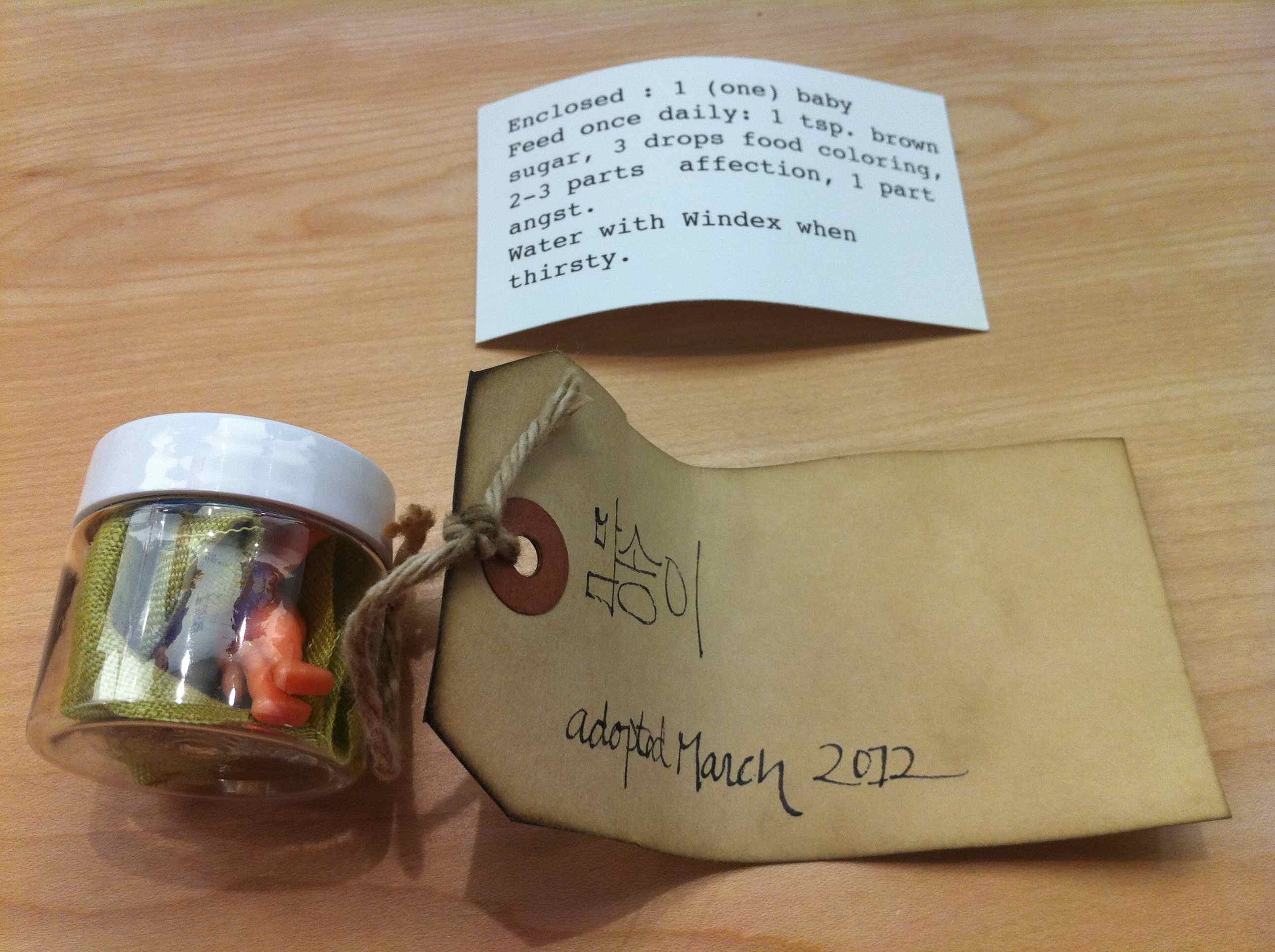

It is true. Ze Frank saves babies. If only it was that easy.
Many of you will know Ze Frank already. He is more than just a comic genius, but provides a refreshing commentary on how we live our lives today. He looks at the small things. He is very good at turning the ordinary into captivating stories.
Earlier this year, I supported a crowdfunding initiative he ran through Kickstarter. He was seeking funding for his new video series- you can find much of it on YouTube. Take a look. Including this piece which he started with: “An Invocations for Beginnings”. See the video which follows at the bottom of these photos.
He had constructed a fish tank inside of which a number of plastic babies had been held captive from plastic lions, sharks and other scary plastic toys. He would save a baby for a particular level of support, and then send that to you.
Here is 밤송이 (“Little Chestnut”), sent to me, named after a fictional character a friend of mine has.
So, we did it. Together with Ze, we saved a baby.
But we all know that this is just for fun. And that this baby is made of plastic. And that this babies parents are a robotic injection moulding system, not real people.
This year, almost 7 million children under the age of five will die. That is a 41% improvement on the 12 million that died in 1990 when the measurement period for the United Nations Millennium Development Goals was started. The objective is to reduce this to less than 4 million under-five deaths per year by the end of 2015. While we have made progress, it is not enough.
This project Life Bridge uses the 10 City Bridge as a stunt to ask how might we use our networks to reduce child mortality? We are all survivors.
Ze’s baby 밤송이 is cute, but not real.
Even though it is not real, and even though it was made as just a joke, it can be used to help paint a different perspective on a serious issue that ought to be seen for the great loss of humanity, and not just masses of statistics.
Would you please join my journey, and support me for the adventure ahead? Visit www.pozible.com./lifebridge where you can help. Do it for 밤송이.
12.12.12 Design Forum

The journey taken during the 10 City Bridge Run will culminate in a Design Forum held in Seoul on 12 December 2012 (12.12.12) to crowdsource good ideas, and to listen and learn from four key questions.
* Q1: What is best practice, and how is that is having an impact? Who is succeeding and why?
* Q2: Is best practice contextually specific? Can good ideas be shared into different and unpredictable environments?
* Q3: What is not working well? Can we map the negative factors that prevent innovative change?
* Q4: How might a human bridge be part of a solution? What might this look like?
An outcome from the Design Forum will be to determine a list of lessons from failure and success titled “10 Tangible Ways To Make A Difference.”
This is a framework to work from, and over the coming three months before the 12.12.12 Design Forum, there will be plenty of good ideas to improve this approach. The Design Forum will be picking up on a great idea from my good friend Kelley Joyce, and looking at ways of how this can be inclusive of other locations outside of Seoul using social media.
Plenty of good ideas. I’m sure you have some of your own. Care to share?
Six Bridges of Connection to Jackie-O
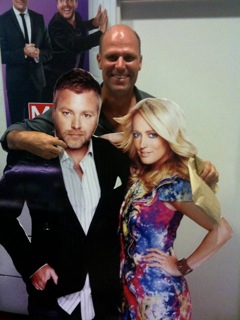
Kyle, Jackie-O. So good to meet last year- can you remember this photo we took together? Ok, maybe you were a little two-dimensional then (just a cut-out). You had a night-time sandwich bar operating at the studio. Getting a free sandwich was good, but not quite as good as what it would be like to meet you in person.
I know that much of what is written about you both sometimes just skims the surface. But I know that you both go a little deeper.
Jackie: great to see Kitty arrive safely into the world, and the photos on your website are just beautiful. Can we talk about your pregnancy? That must have been a life-changing experience for you and Lee, not just the complications before birth but more importantly everything you have blessed with since. It is wonderful news!
I am running 10 sub-marathons each of 24 km in 10 cities across 10 countries all inside of one month starting 10 October this year to raise awareness for how we might help to alleviate child mortality. Your story inspires me Jackie. Would you be open to helping inspire actions that make healthy births a reality for many in the developing world who presently face a 20% chance of tragedy?
Love to talk. Can we? Will you? Please join me in the journey to make a difference.
You can read more here at http://www.pozible.com/lifebridge.
Buy A Bracelet, Sooth Some Guilt. Will Kony 2012 Peak?

Starting a global conversation around how injustice is defined is entirely worthwhile to my mind.
From one perspective, as it relates to Kony 2012, it really doesn’t matter whether someone is Most Wanted #1 or so far down the list that they don’t get a mention by name. The best thing that might come out of Kony 2012 is seeing that celebrity figures are not always right (and that we should think for ourselves), that policy makers most often act because of an unstated agenda (and that we should be vigilant), and that removing a Kingpin does not stop the rot or end the war (this is an incredibly naive view which is seen tragically too many times. The capture and death of Saddam Hussein and Osama Bin Laden spring to mind immediately).
40 million views is a lot of activity. Can we have enough faith in the human condition that people can wake up to themselves when they realise that the assumptions behind the Theory of Change of Kony 2012 is flawed, and that we all must take some responsibility for ending bad things where we can?
The tragedy in Kony 2012 is that it reinforces an unthinking acceptance for supremacy of Western intervention. The great opportunity now for Kony 2012 is for bottom up refinement to a simplistic campaign. There is massive support which can be mobilised – not for the arrest and death of Kony (which could be argued as almost inconsequential given the current situation) – but more for a rethinking of what needs to be done to support Uganda and the region. Would Jason Russell be strong enough to open the conversation by saying: “OK, we got it wrong on this one. I know that there is something to be done in that region, but I am not completely sure of the answer. How can Invisible Children (IC) repurpose itself to make a real difference?”
I suspect that IC is too entrenched in the campaign to make this change, but even so the discussions around the edges, like this one, are what is most important.
The question I would leave you with is this: “what action would you suggest I take in order to make the most difference to alleviating child mortality? Would you be open to working together to making a difference in this area?”
Listen to me please, some things need to change.

Hello world, Me again- I’m back!
I hope you haven’t felt neglected since I last wrote. Yes, it has been a while, but rest assured I have been thinking of you a lot in that time.
I suppose you are wondering what is going on with the 10 City Bridge Run. In fact, maybe you are asking is anything going on with the 10 City Bridge Run?
The last couple of months have been a much needed source of reflection and reorientation, and the answer the question above is unequivocally ‘YES!’
Let me spell what that is in more detail in the blogs that follow. Importantly, we must both understand that some things need to change. You an I both know that.
Sure, the vision needs to be more clearly articulated. And the site is very busy with information.
But I am talking about something much bigger than that. You and I need to get to the heart of what this is about: bridging relationships to reduce child mortality.
There is some work ahead I am going to ask you to join me in doing. Taking photos of human bridges. But it’s ok, it is not a big ask, but I do need your help.
I can’t do it without you. I have only come this far already because of your support, even if you didn’t know that.
Please don’t give up on me now! Thanks for your follow. It means the world to me!
Matt
PS. Would you RT or repost? I can’t tell everyone this myself.
I’m Back! (to the blog, and from Papua New Guinea)

I just returned. Both to writing the blog, but also from a near life-changing experience in Papua New Guinea.
Papua New Guinea is a fascinating country. Truly the land of the unexpected. Arguably the most diverse country on earth, in every respect. Also a country which has been raped by years of colonial and neo-colonial intervention.
Papua New Guinea is a country rich in resources. An article in the Sydney Morning Herald yesterday quoted Stephen Promnitz who is still involved in mining interests in Papua New Guinea as a chief executive and formerly a young geologist with CRA who later merged with Rio Tinto. The article explained:
The 1988-89 (gold) rush left an impression. “It was the most astounding thing I have ever seen. There was more gold than you could poke a stick at. So much so that I thought I would never be looking for gold again. The locals were shaking gold nuggets from the roots of the grass. Some of the nuggets were the size of goose eggs“.
With so much abundance in resources, why then does PNG now have a near epidemic in HIV (close to sub-Saharan African levels) and the second highest rate of child mortality in Asia Pacific? Why is the average weekly salary for most people around K15 (about AU$4)? Forget US$1.25 per day…
I returned with fresh eyes seeing how child mortality is an important issue, and more than ever before I want you to be involved. I started taking photographs of human bridges while I was in PNG, and will post the link on Flickr here shortly. I deleted a whole bunch of photos accidentally (including some priceless photos of human bridges), which in itself was good food for thought- what did I really value: the photos or the emphasis on reducing infant mortality?
Taking photographs of human bridges was instructive. Approaching it from a Western mindset of order and sound structure just doesn’t work. People have their own ideas of what it means to build a bridge, and it is refreshing to see this human creativity at work, even if the finished project is a little lumpier than the perfect bridge that you might have wanted to see from the other side of the camera lens.
Sorry about the absence from the blog- a lot has taken place over the last month or so since I have been writing. To start, my friend Aaron suggested the focus of the event be squarely placed on the photographs of human bridges- after all, this is where the real work is in this initiative. This meant that no running will occur until 24,000 photographs of human bridges have been collected. This is a collective effort.
Earlier I had intended to start running on 1 March, and so this change meant I had pushed the start date to coincide with the Paris G20 Summit which was then scheduled for June 2011.
This suggestion was followed by news from my friend Mark that the Paris G20 Summit has been shifted to November- the G20 will now only meet once annually. This is in fact good for me. Consequently, the run will now take place across November to highlight to the outcome of the photographs gathered. It will travel through 10 countries, and while I will visit Paris, I don’t intend going to the G20 Summit itself- that money is better spent elsewhere. I intend to be running with other people in each city. It is fresh canvas again.
The timing change is good, not because it gives more time for preparation, but because it gives adequate time to focus on the curating of 24,000 photographs to form a pictorial petition to be given to the G20 leadership ahead of the November Summit. One photo for each child that dies on any given day (using 2008 figures). To reduce the infant mortality rate to achieve the United Nations Millennium Development Goals target requires a further reduction of 10,000 deaths daily every day from the present infant mortality rate which sits are around 21,000 children under five who tragically and needlessly die daily.
Let’s get to work. Good to be back. Join me on this journey- I need your help.
George Clooney: Life At Risk From Disease

The actor George Clooney contracted malaria while visiting Sudan earlier this month. Ladies, please don’t fret as he has already beaten the disease! Phew! That was close. Global news agencies around the world can now relax…the crisis has passed. “I guess the mosquito in Juba looked at me and thought I was the bar,” Clooney said.
The crisis has passed for George. Not so for the 700,000 children who will die from malaria every year. While prevention is achievable to reduce this disease considerably, its high prevalence continues.
In a statement, Clooney said his recovery “illustrates how with proper medication, the most lethal condition in Africa, can be reduced to bad ten days instead of a death sentence.” So easy to say…so difficult to achieve.
All the more tragic that the world really cares when George Clooney contracts an illness. “With proper medication” it is resolved. Let me ask you: do we stop caring once George is back on his feet and joking around about this disease?
What is the real tragedy here?
John 10:10

I’m asking people to take photos of ‘human bridges‘ while I am out running during the 10 City Bridge Run during March. The intention is to present 24,000 photos of ‘human bridges’ as a pictorial petition to appeal to the leadership at the Paris G20 Summit in June 2011. Together along with the G20 leadership, can we create a ‘life bridge’ that “focuses on concrete measures…to make a tangible and significant difference in people’s lives“ by making specific mention of child mortality in the G20 Final Declaration when mentioning extreme poverty?
My personal belief as a Christian brings another dimension to the metaphor of ‘life bridge’. Jesus is recorded saying at John 10:10 something which might sound far-fetched in the light of suffering that exists from child mortality:
The thief comes only to steal and kill and destroy; I have come that they may have life, and have it to the full.
Can this be true for all people especially those living in the worst of poverty? We ought to look to the needs of those living in poverty, and at the same time recognise that there is a deeper spiritual poverty underlying this issue which ultimately needs to be addressed. The Bible calls Christians to act: “Faith by itself, if it is not accompanied by action, is dead (James 2:17)”.
Few people would argue against reducing child mortality, and it is certainly not a concern exclusive to Christians. There is nothing new about the idea that we have a strong moral obligation to help those in need- it is common across all cultures. Muhammad Yunus is widely recognised for his work in microfinance and well deserved his awarding of the Nobel Peace Prize in 2006. The Chinese philosopher Mencius (second only to Confucius in influencing Chinese thought and regarded as the most authoritative interpreter of the Confusian tradition) and ‘King Hui of Liang’ who lived around 300 BC had this exchange about helping the poor as Mencius arrived in the king’s court:
There are people dying from famine on the roads, and you do not issue the stores of your granaries for them. When people die, you say: “Is it not owing to me; it is owing to the year.” In what does this differ from stabbing a man and killing him, and then saying: “It was not I, it was the weapon?“
The distinction I would make is that Christians have a particular responsibility to take action. Regardless of what you believe, I hope you will join me in building human bridges to form a ‘life bridge’ with the potential to transform the lives of many.
Hope for the vulnerable: A Christmas reflection

The story of Christmas as it is told is a little bizarre, even completely weird. Allegedly, if we are to believe the Christmas narrative, it involves a bunch of angels appearing and delivering messages, first to two women who were relatives, and then later to a group of shepherds minding their own flocks.
Whether you believe this narrative or not, I think it provides a story of hope for those who are most vulnerable – newborn babies entering the world. Not just newborn babies, but in this story a baby who was also homeless, born into poverty, and into the care of a young and ill-prepared mother.
Life is such a fragile and precious gift, and we too often just take it all for granted. For me, the Christmas message this year is about the possibility for hope and transformation in all of our lives through the birth of a baby called Jesus. In particular, this year I am thinking about how this relates to the calamity of child mortality – is it realistic that we might we also claim a sense of hope and transformation there are well?
I often think that the book which records this Christmas message, the Bible, is often greatly understated leaving much to the imagination. We could do worse than echo the hope given to a bunch of vulnerable shepherds, who responded in this brief vignette recorded in an historical account from a physician called Luke:
When the angels had left them and gone into heaven, the shepherds said to one another, “Let’s go to Bethlehem and see this thing that has happened, which the Lord has told us about”.
Xander
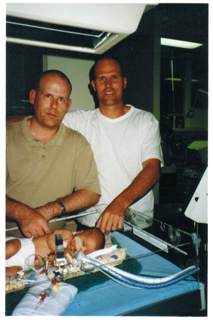 I want to introduce you to Xander, by brother’s son who tragically died about 36 hours after he was born.
This is my own personal experience with child mortality, seeing how my brother and his wife were affected by this bitter and cruel event.
If this is what it feels like when the chances of it happening are so remote, what must it be like when there is a 5:1 change of it happening in communities where young children are not named until their first birthday?
I will take this photograph with me when I leave Sydney. The child mortality I seek to influence is coincident with extreme poverty. This photo, where my brother and I together make a bridge each connected to his young boy gives me some context so that this is not just another string of statistics.
I am sure many people reading this will have their own stories and experiences. Please take time to ensure you address this issue. Please join with me over the coming month to make these experiences have meaning.
- ← Previous
- 1
- 2
- 3
- Next →
 Building Bridges