Bridge
I love a blank canvas. I see opportunities.

Building human bridges. This is the focus on the 10 City bridge Run. Building a human bridge is a design challenge for you and your friends to resolve. The form and function, how many people, the story, how large or small. These are all decisions for you. But note the bridge is also metaphorical of addressing child mortality as part of the solution to this problem. Will that also be part of your narrative?
During March 2011, I am asking people around the globe to build and then take photographs of human bridges. These photographs will be collected and curated as a ‘pictorial petition’ for delivery to the G20 Summit in Paris asking them to make a decision which specifically mentions reducing child mortality in their Final Declaration after the summit meeting in June 2011.
Lindy Johnson from the Queensland Government’s Creative Industries Unit expresses a vision which could be a motivation for building a human bridge:
I love a blank canvas. I don’t see roadblocks, I see opportunities.
Why a bridge?
The bridge is an important metaphor for joining people, institutions, conversations, ideas, communities and places together. The bridge is a universal metaphor. Everyone understands the purpose of a bridge is and how it is used. A bridge has multiple functions, including:
- Crosses a gap. Overcomes differences.
- Joins two or more communities that otherwise are separated.
- Gives more options.
- Makes travel easier.
- Connects cultures, ideas, differences.
- Requires work from both sides for it to be structurally sound.
- Good foundations needed, along with spans of the right material and length, as well as stable supports.
- Allows help to be given. Allows someone to accept help when offered.
We seek to build a bridge between the United Nations Millennium Development Goals (MDG) (specifically Goal 4: Reduce Child Mortality) and the G20 (19 largest economic nations and the EU). This bridge requires the participation of many people to make this happen.
Xander
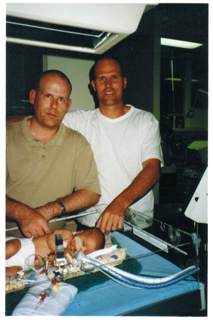 I want to introduce you to Xander, by brother’s son who tragically died about 36 hours after he was born.
This is my own personal experience with child mortality, seeing how my brother and his wife were affected by this bitter and cruel event.
If this is what it feels like when the chances of it happening are so remote, what must it be like when there is a 5:1 change of it happening in communities where young children are not named until their first birthday?
I will take this photograph with me when I leave Sydney. The child mortality I seek to influence is coincident with extreme poverty. This photo, where my brother and I together make a bridge each connected to his young boy gives me some context so that this is not just another string of statistics.
I am sure many people reading this will have their own stories and experiences. Please take time to ensure you address this issue. Please join with me over the coming month to make these experiences have meaning.
What Can I Do?

Jacqueline Novogratz of the Acumen Fund in closing a conference at The Aspen Institute asks perhaps the most important question in influencing extreme poverty: What Can I Do?
She observes the most important thing is our human connectedness. Participation. Collaboration. Bridge building.
Elsewhere in her book titled The Blue Sweater, Novogratz tells a story which symbolises how we are all connected.
This clip gives five pragmatic actions anyone can participate in to make a difference. Her sense of urgency and passion for this situation is evident.
The ability of the individual to influence extreme poverty is what the 10 City Bridge Run seeks to address. Not with lone souls fighting against poverty, but rather together building bridges to make a difference through collective action.
Stop and ask yourself now, yes now, seriously- stop and ask yourself:
What can I do?
Shooting Poverty

Oxfam explore communicating poverty through film. This is a great initiative shared by my mate Ted featuring a short film: Bang for Your Buck.
In Burundi, Africa, a grenade costs the same price as a pint of beer.
Check out this clip and share it to rate the video. It is a story worth telling.
How can we use creative expression as a way of communicating complex themes, particularly to an audience whose attention is difficult to reach? The audience I am addressing through the 10 City Bridge Run is the leaders of the G20 member states. This is about collective action and collaboration- it is not something I can do on my own, and it represents the voice of many individuals coming together.
How might we best capture ‘human bridges’ on photograph for use as a pictorial petition?
Tell A Story- Your Story

Ridley Scott gives good instruction in this clip below titled Life In A Day. It was part of a collaborative video project he started earlier this year.
Scott gives two good pieces of advice in telling a story through capturing an image:
- It must be personal.
- Capture what appeals to you as the photographer/curator.
The 10 City Bridge Run is about participation. Not a spectator sport. It is about bridge-building. During the 30 days that I am running I will be seeking 24,000 photographs of ‘human bridges’ which will then be collated and sent to each leader of the G20 member states as a pictorial petition to appeal for action to reduce child mortality as a way of influencing extreme poverty.
What we do matters. It is not about waiting for the G20 countries to act- that is largely outside of our immediate influence. We can determine our actions, and make them meaningful.
Build the bridge. This is a powerful metaphor. How are you going to tell your story of a human bridge and what this means to make a difference?
Connect ideas, don’t protect them. Build bridges to a better future.

This morning at Sydney Coffee Mornings meeting at Single Origin, my mate Gregg was talking about seeing ideas as networks echoing a TED Talk. That this conversation was in a cafe was not a coincidence, but only exemplified what the talk was about. Watch Steve Johnson present this TED Talk here:
Steve talks about metaphor. Coffee houses providing the incubation place for an idea.
He cautions that a lot of ideas have a slow incubation period. The falacy of the ‘Eureka!’ moment. The long hunch, as he describes it. Steve asks:
How do we allow hunches to connect with other hunches?
Another metaphor I am exploring through the 10 City Bridge Run is that of a bridge. How might we design a bridge to incubate the ideas that make a difference to extreme poverty?
Soon I start running 10 sub-marathons each of 24 km in 10 cities across 10 countries inside of one month. Each distance represents the 24,000 children that die every day. The run itself is bridging cities, conversations and communities.
The real work of participation is collecting 24,000 photographs of human bridges to be used as a pictorial petition to be presented to the G20 leaders. This is an idea that is emerging and still needs some work to refine and spread. So how do we allow hunches to connect with other hunches?
Will you join us over the next few weeks before I commence running during an informal event: ’10 Cafes in 10 Days’? I thought we could start at Single Origin Roasters Cafe at 64 Reservoir St, Surry Hills on Wednesday 27 October (how is 8.30 am- 9.30 am?) and see where it goes from there. Coffee anyone?!
Stop and listen to someone else’s story: Be the bridge

Get inspired!
Each one of us can do amazing things in the world. Take the time to listen to another today- build a bridge to understand them better.
We all have an enormous capacity for love. Void if not used before use by date (death).
Jessica Jackley co-founder of Kiva tells her personal story here at TED. It is an emotional appeal.
How can you be the bridge for another today?
Stop the Clock!
Two days before beginning the journey, I need to make another difficult decision to delay the commencement of the 10 City Bridge Run.
- Do I go now because I said I would and risk being stranded with no cash mid-journey (in the event no sponsorship is raised during the run)?
- Do I just say it is too difficult (and in effect impossible) and give up, refunding all sponsorship received?
- Do I postpone the event, risking the integrity of ‘the bridge’ framed between the September UN Conference and the G20 Summit? Postponing also introduces significant considerations around adverse weather conditions. Soon it will be winter in Korea- not ideal for running.
I started thinking about what I had been learning about the Millennium Development Goals (MDG) over the last week especially through writing my blog:
- The likelihood of failure in meeting these in their entirety
- The excuse of the global financial crisis setting back earlier achievements with the MDG prior to 2008 (this is the reason cited for failing to deliver on commitments to the United Nations by many countries)
- The worsening situation of preventable unacceptable conditions in many locations, particularly sub-Saharan Africa
If you think that a delay of starting the run by a month is bad, consider these MDG.
Of course, there is no going back in time. I can’t make it September again. That is impossible. Neither can we make it 2000 again and retread progress of the MDG.
The reality is that there are not two days to go for the 10 City Bridge Run. There are 1905 days to go until the end of 2015 when the MDG will be assessed. This is what matters.
Rather than be frustrated, I ask you to consider the opportunity presented to optimise the impact of this 10 City Bridge Run.
The 10 City Bridge Run is a creative process of inquiry. It is a challenge. It is testing ‘the impossible’. It requires a little more effort than usual.
The bridge that has been defined between the United Nations Conference (20-22 September) and the G20 Summit on 10-12 November is far from redundant. It has formed the first of many (figurative) bridges that will be crossed. The G20 Summit becomes the near bank supporting a journey that bridges countries, bridges conversations, and bridges the small actions of many.
This journey is raw, real and live.
Thoughts, concerns, questions or advice? I welcome all feedback.
- ← Previous
- 1
- 2
- 3
- Next →
 Building Bridges