Month: September 2010
10 City Bridge Run- Objectives 1, 2, 3.
There are three objectives for the 10 City Bridge Run:
- Raise the awareness of an individual’s capacity to act to positively influence the eradication of extreme poverty from our world.
- Make representation of a global ‘pictorial petition’ to the G20 leadership at the 2010 G20 Summit to be held in Seoul as well as to the United Nations Secretary General. The ‘pictorial petition’ will be in the form of a book featuring 24,000 photographs of people as ‘bridge builders’- connecting with each other symbolically to raise the awareness of this issue.
- Identify 10 actionable items which people across the globe can participate in which will make a difference over the next five years to help in the eradication of extreme poverty. These action items are not pre-determined, and will be arrived through a crowd-sourcing process during the month of running.
Join us on the journey: be part of the difference that makes a difference.
Is the seemingly impossible possible? Muhammad Yunus and the idea of a ‘poverty museum’

Professor Muhammad Yunus who was awarded the Nobel Peace Prize in 2006, during the Skoll World Forum of Social Entrepreneurship held at Oxford earlier in 2006 spoke of his idea of a ‘Poverty Museum’ to be built in the future when extreme poverty is finally eradicated. As I listened to him speak, I remember thinking that this was an interesting idea, but maybe too fanciful, even impossible. But think again: we can now read Charles Dickens and learn about a form of poverty that is all but historical in the UK, or we can visit a museum in South Korea and learn about the poverty experienced after the 1953 Truce across a country which had a GDP the same as Ghana in 1960, and is now recognised with a strong economy.
Much has been written about this issue. Not everyone agrees with each other.
Five years short of the 2015 reporting date for the United Nations Millennium Development Goals and how is our progress?
In 2008, 8.8 million children died before their 5th birthday. 0.1% of these deaths were in the “Industrialised World”. A staggering 50% of the deaths occurred in sub-Saharan Africa alone.
This equates to more than 24,000 children who tragically die every day.
The silent killer is preventable illness caused from the effects of extreme poverty.
What might this be compared with?
To put this into some perspective, consider that this might be seen as equivalent with:
- 1 child dying every 3.6 seconds
- More than 16 children dying every minute
- A 2010 Haiti earthquake occurring every 10 days
- A 2004 Asian Tsunami occurring every 10 days
(Source: UNICEF The State of the World’s Children Special Edition: Celebrating 20 Years of the Convention on the Rights of the Child, November 2009, p.18-19)
It is not all bad news either. Taking a longer term view, since 1960 (when child mortality numbers were first being recorded) the annual number of child deaths has more than halved, from 20 million in 1960 to just 8.8 million in 2008. However, even though child mortality figures have shown a declining trend across the last 25 years, the situation which the world faces compounded by multiple systemic crises is still nothing short of outrageous: the effects of climate change mixed with the hyperinflation of world food prices, complicated by a looming economic stagnation of the West…
Progress has been made, but it is unevenly distributed. We continue to live in an imperfect world. Neither the UN nor the G20 has any magic wand to solve problems. The allocation of aid on its own will not solve this problem. Money makes a difference, but it is far from all there is. This year, natural events in places like Haiti and Pakistan show the constant demand for aid and support. Realistically, how much of this issue will be tackled by the G20 in the short space of time the leaders have together? How much impact might a ‘pictorial petition’ have with leaders meeting around an agenda influenced by complex issues with significant momentum? We could always do nothing and just complain about what a mess the world is in…
Let me provide an alternative and suggest you join us and become a bridge builder. Contributing a photograph while this crazy ’10 City Bridge Run global endurance challenge’ is being conducted might not seem like much, and might well represent nothing more than a symbolic act. However, what is the cost to you? It takes no time, and besides it is free. So snap off a photo and send it to us for inclusion in the book. And while you are at it, maybe open a conversation about this issue with others. More than likely, this is already something you are working on or have contributed towards. We recognise that many excellent initiatives are being undertaken by humanitarian workers quietly and selflessly making a difference. We would love to hear you thoughts.
Read about the outcome we hope to influence and the outputs we will be crowd-sourcing and co-creating through crowd-funding the necessary financial resources to make this work.
Lost in Riverview

Saturday evening I headed out for a 24 km training run, but was confounded as darkness fell and I became geographically embarrassed in the streets of Riverview.
For those unfamiliar with Riverview, it is a leafy enclave of a suburb nestled snugly in the North Shore.
 From Riverview you are able to enjoy spectacular views of the Sydney Harbour Bridge, and running at first I saw it over my left shoulder, and then later (thinking I was still headed in roughly the same direction) I saw it over my right shoulder as I looked around to check on surrounding landmarks. As soon as I realised I was going in a big circle I stopped to ask some kids kicking a footy on the street how I might run back to Sydney. They thought that was one of the most ridiculous things they had heard in their life…too far away for running!
Riverview is a privileged suburb, and enjoys beautifully designed large houses, sporty cars, and well maintained gardens. Speaking with the kids playing kick-to-kick I soon discovered there were no buses operating at that time of night, and the nearest train station was miles away.
Not only was I miles away from where I would have preferred to have been, but I became aware I was worlds apart from the situation where people live in extreme poverty- the two environments are almost without comparison they are so completely different.
With no option but to run my way out of the problem, it became a problem solving exercise and a test of mental stamina and toughness that running training develops. After a certain stage in training when fitness has been proven, much of the training becomes more about a competition within yourself: will you blow off training one night? can you run hard when it hurts? will the small niggling pain that you feel (which every athlete gets and endures) eventually make you decide that it is just not worth it?
I worked my way out of the situation and salvaged the run. I passed an unfortunate car prang along River Road and thought that things could always be worse. When I finally was back onto ground I was familiar with and crossing the Fig Tree Bridge, then across the Gladesville and Victoria Bridges, I felt a great sense of achievement known to those who have experienced ‘the loneliness of the long-distance runner’.
As I came off Victoria Bridge, I felt I had proved enough to myself and a bus came tearing along the road, close enough for me to catch back to Town Hall.
For a short period of time I was contemplating: ‘was the seemingly impossible possible?’ The discipline of overcoming small challenges gives us the strength to combat the larger problems we encounter. Maybe this has some relevance to how we can address the situation of extreme poverty: a lesson from the most unlikely of places, Riverview.
Seth’s response

I subscribe to Seth Godin‘s blog. Daily, Seth posts a few small words encasing a big idea to think about.
I emailed Seth a few days ago about a question I had in relation to what he had written, and his response gave me more food for thought.
My question was about leadership. His answer basically encouraged me to keep going in the same direction. My reflection on Saturday was:
Leadership presents both opportunity and responsibility. Often the temptation is to first find validation or comfort through following others. Leadership in fact involves rising above this temptation and, through your actions, writing the narrative for those who follow.
The work required to eradicate extreme poverty involves some of this pioneering leadership, a lot of innovation and many to follow making good with what appears to work. Not everyone needs to lead, but not everyone should follow either.
What role are you playing? Leader? Innovator? Follower? Bystander? All of the above?
Training log: 11 September. 24 km scheduled harbour run…and ended up a little lost

Saturday evening I headed out for a harbour run which joins up the land mass through a series of seven bridges. Crossing the Sydney Harbour Bridge first, I headed across towards Gladesville with an intention of coming back across the Iron Cove Bridge and ANZAC Bridge before crossing the Pyrmont Bridge back into Sydney city.
This run is varied for terrain, both undulating and across some scramble goat-tracks tucked within the northern banks of the harbour- a truly beautiful walk if running doesn’t float your boat and you are in Sydney. If you want to take a walk, leave a comment I will give you directions to the best start point for access by public transport. Many parts show wonderful rock walks with plenty of mangrove like vegetation.
I ran counter-clockwise given that I started the run late and I had planned to have reached the Fig Tree Bridge in Gladesville by nightfall (the route is across small dirt tracks before then so going would be made slow by poor visibility after the sun set).
I took longer than I anticipated getting out to Riverview, then because I was used to running this route clockwise I sort-of became lost as you can see by the photo map between 9 and 14 km…a little bit of backtracking.
Read the next post I will write about being ‘Lost in Riverview’ because it was a good experience of having to rely upon the mental stamina and toughness that running develops. After a certain stage in training when fitness has been proven, much of the training becomes more about a competition within yourself: will you blow off training one night? can you run hard when it hurts? will the small niggling pain that you feel (which every athlete gets and endures) eventually make you decide that it is just not worth it?
I worked my way out of the situation and salvaged the run, crossing the Fig Tree Bridge, and then across the Gladesville and Victoria Bridges before catching a passing bus back to Town Hall Station. Ordinarily I would have run the distance back to Sydney, but it was getting much later than I had intended to stay out for, I knew I had covered about the distance I was wanting to train over, and there was nothing to prove by running it home as there were no gains in fitness and probably more to lose in fatigue. I think it was a good judgement call, although some of the passengers might have been less than impressed sharing part of the bus ride with me…
I maintained time of the overall run, no heart-rate data and measured weight before and after the run.
I felt confident across the distance, and am looking forward to the first run in New York on 24 September.
Earlier on 11 September a spirited gang of supporters ran and walked from the Sydney Opera House across the Sydney Harbour Bridge to the other side of the harbour where we enjoyed breakfast. More on that in a following post.
Pause and reflection: musical interlude on 9/11

This morning we launched the 10 City Bridge Run with a spirited gang of runners and walkers rejoicing in glorious Spring weather to cross the Sydney Harbour Bridge to Milsons Point. Photos and more details later this evening.
Today is also the 9th anniversary of 9/11. What a decade! Some writing over the past nine years has spoken about the importance of eradication of extreme poverty because of the strategic gain it presents in the so-called ‘War Against Terrorism’. While this might be a desirable indirect consequence, our efforts to eradicate extreme poverty should have the aim of ending needless suffering so unevenly distributed across the world.
Here is a musical interlude from The Black Eyed Peas reminding us that too many Bridge Builders is never enough. The is still much more work for all of us to do.
Its time to change the narrative, and a positive outcome is truly within our reach. The Millennium Development Goals provide a useful framework through which to work toward the eradication of extreme poverty. The journey ahead over the next 42 days for me is as much a process of learning and inquiry- I don’t have the answers, let alone a few comprehension of the issue in its entirety.
Please join me in learning more about the issue of extreme poverty and what is actionable to make a meaningful difference through our own actions.
Counting down (to 2015)

Check out the link to the Countdown to 2015 initiative I received sent through from my mate Stephen Mayers here in Sydney.
Another example of some of the great work and focus people are bringing to the urgency required to address the achievement of the Millennium Development Goals.
A summary might be that there are many reasons to be optimistic about progress toward achievement of the Millennium Development Goals, however the progress has been unevenly distributed. It is time to seriously focus on a countdown toward the time horizon set to achieve these goals of 2015.
Take some time to click through this site and watch the embedded video. What is your response?
Did you read the news today!!! It’s all over! Poverty ends for ever!
 Well, maybe not just yet…
Check ou this video that the guys at the Global Poverty Project have come up with. It is a little fun, and provokes some thought.
What is clear from this video is that there is a lot of other great stuff happening all over the place already. This is not about one initiative standing out above another, but together all of these efforts can make a difference, just as together our tiny voices can be heard.
What do you think: Do your actions really count?
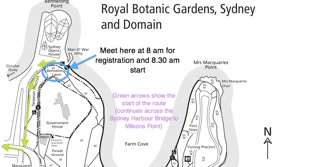
Come and join us for the global launch of the 10 City Bridge Run tomorrow meeting at 8 am just behind the Sydney Opera House for a 2.4 km run/walk across the bridge to Milsons Point. Maybe we might fall short of the 100 people, but that is not the point. Much like the Millennium Development Goals, there is still a lot of work to do. How can we improve and achieve what is the desired standard (of 100 people together running 2.4 km) before the G20 Summit begins in Seoul?
We do have a good crowd running. Come and join us. Be present at the start of this journey.
Training log: 9 September. 16 km Rose Bay- Bondi Circuit


Good run across 16 km tonight with some good undulating ground. Headed out just after a sprinkling of rain so the air was fresh and cool, and about 20 minutes before ending some welcome light, cold rain started falling.
The course departed Hyde Park to Rose Bay via New South Head Road, then heading south to Bondi via Curlewis St and returning to Hyde Park via Bondi Road and rejoining New South Head Road through Ocean St.
This is a good course- good views and with some good flat stretches mixed with some ups and downs that make for a challenging run.
I felt fresh tonight, and ended strong feeling in good shape. I didn’t time the run by across the three ‘legs’ (Rose Bay, Bondi and finish) but did keep track of total time taken. I as maintaining a reasonable and comfortable pace, but not smashing any land speed records either. I didn’t measure heart rate, but did note weight before and after the run.
For anyone training for the City to Surf next year, this is a good course to keep in mind.
On the homeward leg I bumped into Jamie Chivers and spoke briefly. Jamie has been active supporting causes addressing poverty in India himself over the last two years.
Agency, brand and trust: help or hindrance?

Bringing in the money is not the most important thing for us to do if we want to eradicate extreme poverty. Clearly that is part of the solution, but if it was the solution then there has been enough invested to make change already, and the end of poverty remains elusive.
I actually think it comes down to ‘political will’. I don’t mean a sharper focus within a country or institutions like the UN or G20, although that is helpful. I actually am talking about our own actions. Where do we place our priorities and what will we no longer accept?
There has been a lot written about consumer advocacy and how this might start to impact on poverty. In some respects, I would place that in the same bag as Corporate Social Responsibility- well meaning initiatives with a narrative around change, but ultimately in themselves they fail to be levers to make change happen. Muhammad Yunus argues this point strongly in his recent writing, and I like what he writes.
There is a need for greater participation, on both incremental and radical interventions. And not just by ‘big brand’ not-for-profit NGO.
Brand and trust have become confused concepts, possibly intentionally. ‘Agency’ starts to trade on a currency of brand because it brings with it high level of trust. Meaningful systemic change suffers for the sake of maintaining that brand.
This is not true of every organisation, and there are some awesome thought leaders and interventions happening most of whom are working selflessly and tirelessly in unseen places because of a driving passion to help others.
Has ‘brand’ gone too far? Is there still room for the maverick social entrepreneur?
- ← Previous
- 1
- 2
- 3
- 4
- Next →
 Building Bridges