Inspiration
10 Reasons to Care

Franklin D. Roosevelt argued “The test of our progress is not whether we add more to the abundance of those who have much, it is whether we provide enough to those who have too little“.
Bill Shore in his book The Cathedral Within writes: “The paradox of our time is that while wealth is being created at unprecedented levels, it is not reaching those in greatest need. If anything, it has created a complacency, a comfort with the status quo, an assumption that a rising tide will lift all boats.” The tragedy is that prosperity masks extreme poverty. This is why bridges are necessary – as much as for us to see what needs exist as much as for those who need help.
Is it worth asking whether we have have gone too far in the commodifying ‘doing good’ such that we see charity as a noun (an organisation) and not as it should be regarded which is a verb (the action of helping others in preference to our own needs)?
Citizen engagement is the new philanthropy. Philanthropy is not necessarily only in the giving of money. Civil society is the difference that makes a difference. We should return to philanthropy’s original meaning as ‘love of humankind’. We have a lot more we can each contribute through our time and talents.
There are no shortage of problems in our lives and in the world. Caring about one problem does not need to occur at the exclusion of others as well. Consider that building a bridge to improve the lives of millions can enrich our own lives through serving the needs of others far outweighing any cost to ourselves.
The need to address child mortality ought to be self-evident to us all. Caring for those people on the planet who have no voice, choice or influence on where and when they are born into extreme disadvantage. Just in case you need further argument, here are 10 reasons why we should care:
- Decent thing to do. Caring for other humans on the planet who are in need.
- Humanitarian intervention. It is wrong to allow suffering when it is within our ability to prevent it occurring at no disadvantage to ourselves.
- Avoids population crisis. All evidence shows that a reduction of child mortality also reduces birth rate, which also reduces the potential of an unsustainable population size in the coming decades.
- Improved environment. Many deaths are caused from simple reasons such as poor water supply and sanitation. To reduce child mortality requires an improvement to disgraceful environmental conditions.
- Preventing disease epidemics. Malaria remains one of the largest killers of children across the world. Improved prevention of disease leads to reduced child mortality. Vigilance against epidemics far worse than malaria is important for everyone.
- Maternal health. 350,000 women will die in labor each year, with most of these deaths occurring in the region defined as sub-Saharan Africa. Reducing child mortality leads to a reduction in birth rate, which lessens pressure on already inadequate medical services and leads to an improvement in maternal health.
- Female education. There is a direct relationship between birth rate, child mortality and female education. Improving female education, which remains at outrageously unacceptable low levels in many countries, results in the reduction of birth rate and child mortality through better care of babies.
- Extremist views. We can only imagine the impact a high child mortality must have in creating a sense of injustice, creating a ripe potential to be exploited by extremist and radical militant groups. This is a time bomb we must diffuse more out of compassion than through a pursuit of our own security.
- Moral responsibility through mining and trade. Many mining interests take place in some of the resource rich countries that ironically experience among the highest rates of poverty. Mining companies are businesses, not charities, but it could be argued that it is in their shareholders direct interests to ensure the best conditions exist for business operations through sound civil order.
- Partnerships. Reducing child mortality requires closer partnerships, which generate other benefits for us all.
Let the dataset change your mindset. This is a question of urgency. We can influence child mortality, but it will require action and not just talk.
Defeat into Victory

When was the last time you were kicked in the teeth by life? It’s painful, isn’t it. Expectations and dreams are ripped apart and broken. Failure is rarely a fun experience, but what is important is to learn for it, and to move forwards. “Fall down six time, get up seven.”
I could reel out here a long list of failure that I have experienced at different times, but won’t- there is no need for it, except to say that being unable to continue with the 10 City Bridge Run last year due to injury from overtraining and lacking sufficient financial support was among the more recent failed endeavours. But now I am back running, and focused on starting the running of 10 sub-marathons each of 24 km in 10 cities across 10 countries all inside of one month on 1 March. Lessons have been learnt.
What is worse for many million people is the lack of choice in their situation. I’m thinking about those children and families who suffer as a result of child mortality. It is a cruel and bitter experience- I remember the toll it took on my brother and his wife. I can hardly begin to imagine what it must be like where there is a 1 in 4 chance of death occurring before the fifth birthday.
What will we say at the end of 2015 when all countries give an account of the United Nations Millennium Development Goals? The window of opportunity for change remains open. With a past career in the military, I draw inspiration from the words of Field Marshall Sir William Slim:
The only test of generalship is success, and I had succeeded in nothing that I had attempted…Defeat is bitter. Bitter to the common soldier, but trebly bitter to his general. The soldier may comfort himself with the thought that, whatever the result, he has done his duty faithfully and steadfastly, but the commander has failed in his duty if he has not won victory–for that is his duty. He has no other comparable to it. He will go over in his mind the events of the campaign. ‘Here,’ he will think, ‘I went wrong; here I took counsel of my fears when I should have been bold; there I should have waited to gather strength, not struck piecemeal; at such a moment I failed to grasp opportunity when it was presented to me.’ He will remember the soldiers whom he sent into the attack that failed and who did not come back. he will recall the look in the eyes of men who trusted him. ‘I have failed them,’ he will say to himself, ‘and failed my country!’ He will see himself for what he is – a defeated general. In a dark hour he will turn on himself and question the very foundations of his leadership and his manhood.
And then he must stop! For, if he is ever to command in battle again, he must shake off these regrets and stamp on them, as they claw at his will and his self-confidence. He must beat off these atacks he delivers against himself, and cast out the doubts born of failure. Forget them, and remember only the lessons to be learnt from defeat–they are more than from victory.
Fight Poverty! Act For Peace!

Overconsumption at Christmas? If you haven’t bought presents yet, and are just jaded by the plastic crap that no one really needs, consider giving money instead to Act for Peace so that people who have very little except from a lot of misfortune can benefit.
My friend Sarah works for Act For Peace. She sent me their promo clip which is fun to watch, but also makes you ask yourself at Christmas: “are we just being sucked into a great big festival of consumerism?” You can do better. Here is an alternative:
I thought the making of the video was worth including as well:
Alive With Possibilities

I met with my friend Janine this morning by chance while she was in the neighbourhood with her mother, and we stopped to talk over a coffee. Her mother, Ruby, is an impressive lady – gracious, good humoured, encouraging, full of life, and passionate.
I had heard previously about her mother’s life in South Africa – an heroic journey! Over coffee, Ruby gave her perspective on possibilities. She mentioned a recent South African tourism campaign called “Alive With Possibilities“. The video is inspiring, and worth watching below (2:02 minutes).
Actually there are two, and the second one shows the diversity to be found in South Africa, let alone across Africa itself as a continent. (a little longer at 5:53 minutes)
“Ok, nice videos, but so what?” you might ask. Why is this relevant to reducing child mortality?
The story of transformation within South Africa is nothing short of inspirational and needs little clarification. Certainly, the journey is not complete, and there is still a lot of progress to be achieved. There is a lot to celebrate all the same.
The same, too, I hope can be said for child mortality in 2015. The problems in sub-Saharan Africa presently are overwhelming. Insurmountable? “An incomplete journey, but much to celebrate“. Time will tell. Our involvement will ultimately determine how this narrative plays out.
Ruby went on to say how South Africa changed the tag-line from “Alive With Possibility” to “It’s Possible!“. Just a few words, but the meaning is completely different. This is the message we should take away for child mortality. It is more than identifying what is possible, but declaring and then working to achieve the possible itself.
During the 10 City Bridge Run, I am asking a question about reducing child mortality: “Is the seemingly impossible possible?” Please join us on this journey.
Maybe Nelson Mandela responded best by saying:
It always seems impossible until its done. (Nelson Mandela)
All I need to do is to believe. (Bishop Desmond Tutu)
Hope for the vulnerable: A Christmas reflection

The story of Christmas as it is told is a little bizarre, even completely weird. Allegedly, if we are to believe the Christmas narrative, it involves a bunch of angels appearing and delivering messages, first to two women who were relatives, and then later to a group of shepherds minding their own flocks.
Whether you believe this narrative or not, I think it provides a story of hope for those who are most vulnerable – newborn babies entering the world. Not just newborn babies, but in this story a baby who was also homeless, born into poverty, and into the care of a young and ill-prepared mother.
Life is such a fragile and precious gift, and we too often just take it all for granted. For me, the Christmas message this year is about the possibility for hope and transformation in all of our lives through the birth of a baby called Jesus. In particular, this year I am thinking about how this relates to the calamity of child mortality – is it realistic that we might we also claim a sense of hope and transformation there are well?
I often think that the book which records this Christmas message, the Bible, is often greatly understated leaving much to the imagination. We could do worse than echo the hope given to a bunch of vulnerable shepherds, who responded in this brief vignette recorded in an historical account from a physician called Luke:
When the angels had left them and gone into heaven, the shepherds said to one another, “Let’s go to Bethlehem and see this thing that has happened, which the Lord has told us about”.
Training Tips 101: When fatigue arrives, be proud!

“Everyone feels pain in the last 6 miles- suck it up”. This, and more great advice from Toby Tanser in the video below. Shot by Mike Kobal using a Nikon D90.
I posted this video earlier in October, but liked it so much thought it was worth bringing back out from the vault.
Posted again now as a tribute to Toby Tanser for his recent achievement running “From the Sea to the Stars” – a charity run to get the last portion needed to break ground on Sub Saharan Africa’s first public kids’ hospital. 250-miles from the Indian Ocean to the ceiling of Africa – Mt Kilimanjaro running!
Other Mens’ Flowers

I was fortunate to spend some time with Fred Chaney over the last two years. He gave me wonderful advice, whether I wanted to hear it or not. That is the sign of someone who really cares- they take the time to tell you the truth, not just put sugar coating on everything.
One conversation he gave some clues about how to have impact which was profound advice. I summarise it by the expression ‘Other Mens’ Flowers’. Here is what it is about:
- Other Mens’ Flowers: Use what others have produced as a foundation.
- Find Fellow Nudgers: We are not in this alone. Collaborate.
- Small evolutions: Big revolutions are actually rare. Focus on getting the small evolutions right.
- Not random interventions: Focus. Stay focused.
- What is the one big game changing idea?: What are you about?
Reflecting on this was on my mind over the last month as I reviewed the 10 City Bridge Run. I need your help to move forward. Please join with me as a ‘Fellow Nudger’ to help change the game and improve the lives of millions.
Squaring the Circle

‘Squaring the Circle‘ describes trying to achieve the impossible. The expression is sometimes used as a metaphor for doing something logically or intuitively impossible.
It is essentially a mathematical problem, and until 1882 it was thought that somehow it might be possible with the use of optical illusions through geometry. But in 1882, properties of ∏ (pi) proved that it could not be achieved.
Sometimes we really want something to be possible, despite the evidence we are presented with. People will tell you: “Just accept it; it can’t be done. It is impossible.”
Some people see the world differently. People like Nelson Mandela who said:
It always seems impossible until its done.
Bridge builders share a spirit of what might be possible. It is an act of faith, of believing in the possibility of what you are doing. A belief that our actions actually matter and can make a difference. A vision of what can be rather than what is.
All successful human endeavors – from breakthrough interventions like the telephone to great social leaps forward like the civil rights movement – begin with the assumption that change is possible. (Quote from ‘City Year’)
I had intended to commence the 10 City Bridge Run on 24 September, and subsequently delayed numerous times for a range of reasons, initially due to funding available. I had planned to be in Seoul right now at the conclusion of the 10 City Bridge run, but instead am still in Sydney.
So what happened? I ended up injuring myself through overtraining. I reached a point where I literally could not run. That was disappointing. I followed the advice of good friends and rested, and over the past month since I last blogged I have been stretching, resting, swimming and cross training using high-cardio interval training with weights in the gym. I expect I will be starting to run again in early January.
We have all encountered failure at some point. What is important is to pick yourself up and push on. To learn from the experience, and try again. Trying something different to see how it might work out successfully.
I reviewed what I had been planning, from the training routine through to what it was I thought could be achieved. The 10 City Bridge Run is tightly focused around child mortality as a lever to help unravel extreme poverty. Please take some time to look at the website and see how it has changed. If it is unclear in any area, let me know.
So, can we ‘square the circle’? Maybe not as an exercise in geometry.
But the 10 City Bridge Run will proceed commencing on 1 March 2011. Please join me on the global design challenge. I need your help. Together, we can achieve the impossible.
Fall down seven times, stand up eight.
Xander
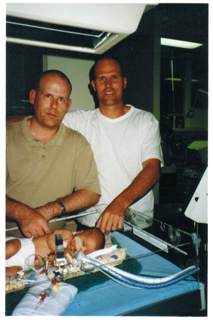 I want to introduce you to Xander, by brother’s son who tragically died about 36 hours after he was born.
This is my own personal experience with child mortality, seeing how my brother and his wife were affected by this bitter and cruel event.
If this is what it feels like when the chances of it happening are so remote, what must it be like when there is a 5:1 change of it happening in communities where young children are not named until their first birthday?
I will take this photograph with me when I leave Sydney. The child mortality I seek to influence is coincident with extreme poverty. This photo, where my brother and I together make a bridge each connected to his young boy gives me some context so that this is not just another string of statistics.
I am sure many people reading this will have their own stories and experiences. Please take time to ensure you address this issue. Please join with me over the coming month to make these experiences have meaning.
Do you need a permit?

Where, precisely, do you go in order to get permission to make a dent in the universe?
This is the question Seth Godin asks us in his blog the previous week. Here is more of his blog comment- I think it is worth taking a minute to read. Subscribe to his blog here.
The accepted state is to be a cog. The preferred career is to follow the well-worn path, to read the instructions, to do what we’re told. It’s safer that way. Less responsibility. More people to blame.
When someone comes along and says, “not me, I’m going down a different path,” we flinch. We’re not organized to encourage and celebrate the unproven striver. It’s safer to tear them down (with their best interests at heart, of course). Better, we think, to let them down easy, to encourage them to take a safer path, to be realistic, to hear it from us rather than the marketplace.
Perhaps, years ago, this was good advice. Today, it’s clearly not. In fact, it’s disrespectful, ill-advised and short sighted. How dare we cheer when a bold changemaker stumbles? Our obligation today isn’t to spare the feelings of our peers from future disappointment. It’s to establish an expectation that of course they’re going to do something that matters.
If you think there’s a chance you can make a dent, GO.
Now.
Hurry.
You have my permission. Not that you needed it.
How did you respond to what he had to say?
I reflected on the journey that the 10 City Bridge Run has taken me on. Uncertainty and doubts at different points, moments where I didn’t have ‘enough’ and so plans had to change or be postponed, and thankfully hearing the encouragement and support from friends and strangers alike when I might have quietly been expecting someone to say something along the lines of: “that’s ridiculous/ it will never work/ have you asked the ‘authorities’?
In a world so consumed with brand, and where we measure success in how social media is ‘liked’ by ‘friends’ it is an empowering act to just start something. It is messy and raw- a lot of time is perhaps wasted trying to work out where it is supposed to be going. It reminds me of the decorating the children did when their ideas fell short captured in my earlier post titled “Tinkering…Come Play!“.
How big is the dent you are currently working on? Did you ever stop waiting for a permit?
- ← Previous
- 1
- …
- 6
- 7
- 8
- Next →
 Building Bridges