Child mortality
Methodology: How I See This Working

I filmed a short video while out doing 8 x 400 m sprint training on the weekend, and shared it here for you to understanding my methodology better.
Check out the video here, and the notes below amplify the message. Let me know if relating this story while I am out of breath between sprints is a distraction at all. I was hoping it added some authenticity to what I have been doing (albeit, would be good if I wasn’t so much gasping!)
Essentially, there are five parts to this journey to help alleviate child mortality:
Part 1: 10 City Bridge Run. The Run.
This is essentially a stunt. Running 10 sub-marathons of 24 km in 10 cities across 10 countries all inside of one month. Is it necessary? I think so. Is it possible? Only if it is funded through crowdfunding at www.pozible.com/lifebridge. Please don’t feel compelled to support me. I am not into guilt trips. If it doesn’t get funded I will have no option other than to close this down. A missed opportunity. We can do better than that.
Part 2: Outcome 1 – The book, ‘Life Bridge’.
This will be a beautifully produced photo-pictorial book with 100 photographs of human bridges. It is something we are going to create, and will tell a story of strength through connection. More on that later.
Part 3: Outcome 2 – Design Forum to be held in each city I run.
This is perhaps the most important aspect of this project. To go and see, and to capture lessons and stories. The Design Forum won’t necessarily be huge. It is the conversation that is important. The conversation will continue long after the Design Forum is completed. Innovation as a process to help alleviate child mortality is what this is about, and the vehicle is a human bridge.
Part 4: Outcome 3 – 10 Tangible Ways To Make A Difference.
From the experience and contribution of ideas people will be making during the journey, especially through the Design Forum, a co-created list of 10 Tangible Ways To Make A Difference will be collated. I owe this suggestion to Charles Tsai, an impressive social entrepreneur from Canada who impact has been felt internationally.
Part 5: Outcome 4 – Three year Plan (2013-2015)
Another great social entrepreneur, Paul Polak, inspired this outcome through his book ‘Out of Poverty: what works when traditional approaches fail‘. Paul argues that working from three-year plans is most effective to create change. This will be the expression of the 10 Tangible Ways to Make A Difference into some measurable way that people can contribute in some form (not simply in money) to help alleviate child mortality.
There is by coincidence a three year window between now and 2015. How might this be used to help bridge the existing efforts with other people who might be able to do more but are not engaged? Worth examining further. I believe so.
I am not promising a silver bullet, nor I am suggesting that this effort will solve a problem where others have failed. We have all failed together. Looking after each other is all our responsibility.
Life Bridge is an aspirational project to inspire the capacity for change. I believe it will make a difference. I do need your support to make this work. I can’t do this on my own, and their is no intention for that to be the case either. Please join me on the journey through sponsoring me at www.pozible.com/lifebridge.
Do me a favour, and please forward and RT this link. I need you to step up. Please help.
Six Bridges of Connection to Jackie-O
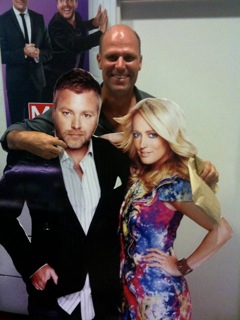
Kyle, Jackie-O. So good to meet last year- can you remember this photo we took together? Ok, maybe you were a little two-dimensional then (just a cut-out). You had a night-time sandwich bar operating at the studio. Getting a free sandwich was good, but not quite as good as what it would be like to meet you in person.
I know that much of what is written about you both sometimes just skims the surface. But I know that you both go a little deeper.
Jackie: great to see Kitty arrive safely into the world, and the photos on your website are just beautiful. Can we talk about your pregnancy? That must have been a life-changing experience for you and Lee, not just the complications before birth but more importantly everything you have blessed with since. It is wonderful news!
I am running 10 sub-marathons each of 24 km in 10 cities across 10 countries all inside of one month starting 10 October this year to raise awareness for how we might help to alleviate child mortality. Your story inspires me Jackie. Would you be open to helping inspire actions that make healthy births a reality for many in the developing world who presently face a 20% chance of tragedy?
Love to talk. Can we? Will you? Please join me in the journey to make a difference.
You can read more here at http://www.pozible.com/lifebridge.
The Not-So-Coffee-Free Friday: Part 2

Today, I have rescheduled my training, and will run six laps between Pyrmont Bridge and Anzac Bridge (4.2 km one way) to cover a 24 km distance. Along the way, I am hoping to stop by for a quick coffee with my good friend Annette Higgins (caffeine is a good stimulant for increasing athletic performance). Consider sponsoring me $4 (you only need to do it once ever)- the cost of a coffee- while I am running.
You can do this through the link here at http://www.pozible.com/lifebridge. It is a crowdfunding site, which means many people contribute small amounts to fund a creative project.
Next week, I will run 20 laps of the Sydney Harbour Bridge (1.2 km one way) during a training run. You are welcome to join me for the whole distance or just one lap. Happy to slow to a walking pace (for one lap) if that suits you best!
Times are tight. I know that. But would you play a small part in my journey by sponsoring me $4?
Actually, there are no small parts in this journey. Everyone has their place, and even $4 makes a big difference to the outcome: helping to alleviate child mortality. Read more about how I believe I can make a difference with your help at the link above.
Thanks for coming on the journey.
Bridging relationships to reduce child mortality.
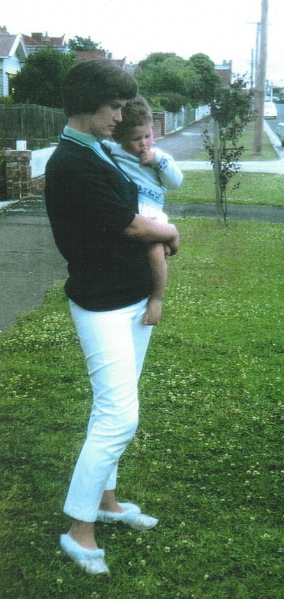
This is a picture of me with my mother when I was much younger- I guess around two years old. We are standing on the nature strip of our old house in inner-city Melbourne. Great photo isn’t it!
Today is my mother’s birthday. Happy birthday Mum! I have come a long way since this photo. A lot has happened in the years between.
The 10 City Bridge Run is about bridging relationships to reduce child mortality.
Life is fragile. Most child mortality tragically is influenced within the first 48 hours of birth. Similarly, maternal health is influenced by the health available during pregnancy and at birth.
The risks of pregnancy and child-birth remain despite our technology. We are just better prepared, educated and equipped to ensure a high proportion of births. In Papua New Guinea where I recently visited, they experience the second-highest rate of child mortality in Asia Pacific. It is something that doesn’t attract much publicity. It is just plain sad.
Building bridges to reduce child mortality is difficult enough to understand as an abstract concept, let alone to do in reality. There are almost too many challenges to consider, but I believe if we together on a global scale focus on relationships to reduce child mortality then change can occur.
Bridging relationships between two people is where this starts. Sure, the ultimate result is across a global stage, but the important start is here between you and me. It is about us. It takes work, more work than wearing a wrist band. It is not always going to be easy, but it will be worthwhile.
Tomorrow I will show you the first small collection of photographs of human bridges that I have taken to communicate how together we can bridge relationships to reduce child mortality. Join me by helping me build this collection and contributing your own photos.
Let me start leading by example with this photo of my mother. Bridging conversations that sometimes seem unbridgeable. Together, we can show that the seemingly impossible really is possible.
Listen to me please, some things need to change.

Hello world, Me again- I’m back!
I hope you haven’t felt neglected since I last wrote. Yes, it has been a while, but rest assured I have been thinking of you a lot in that time.
I suppose you are wondering what is going on with the 10 City Bridge Run. In fact, maybe you are asking is anything going on with the 10 City Bridge Run?
The last couple of months have been a much needed source of reflection and reorientation, and the answer the question above is unequivocally ‘YES!’
Let me spell what that is in more detail in the blogs that follow. Importantly, we must both understand that some things need to change. You an I both know that.
Sure, the vision needs to be more clearly articulated. And the site is very busy with information.
But I am talking about something much bigger than that. You and I need to get to the heart of what this is about: bridging relationships to reduce child mortality.
There is some work ahead I am going to ask you to join me in doing. Taking photos of human bridges. But it’s ok, it is not a big ask, but I do need your help.
I can’t do it without you. I have only come this far already because of your support, even if you didn’t know that.
Please don’t give up on me now! Thanks for your follow. It means the world to me!
Matt
PS. Would you RT or repost? I can’t tell everyone this myself.
I’m Back! (to the blog, and from Papua New Guinea)

I just returned. Both to writing the blog, but also from a near life-changing experience in Papua New Guinea.
Papua New Guinea is a fascinating country. Truly the land of the unexpected. Arguably the most diverse country on earth, in every respect. Also a country which has been raped by years of colonial and neo-colonial intervention.
Papua New Guinea is a country rich in resources. An article in the Sydney Morning Herald yesterday quoted Stephen Promnitz who is still involved in mining interests in Papua New Guinea as a chief executive and formerly a young geologist with CRA who later merged with Rio Tinto. The article explained:
The 1988-89 (gold) rush left an impression. “It was the most astounding thing I have ever seen. There was more gold than you could poke a stick at. So much so that I thought I would never be looking for gold again. The locals were shaking gold nuggets from the roots of the grass. Some of the nuggets were the size of goose eggs“.
With so much abundance in resources, why then does PNG now have a near epidemic in HIV (close to sub-Saharan African levels) and the second highest rate of child mortality in Asia Pacific? Why is the average weekly salary for most people around K15 (about AU$4)? Forget US$1.25 per day…
I returned with fresh eyes seeing how child mortality is an important issue, and more than ever before I want you to be involved. I started taking photographs of human bridges while I was in PNG, and will post the link on Flickr here shortly. I deleted a whole bunch of photos accidentally (including some priceless photos of human bridges), which in itself was good food for thought- what did I really value: the photos or the emphasis on reducing infant mortality?
Taking photographs of human bridges was instructive. Approaching it from a Western mindset of order and sound structure just doesn’t work. People have their own ideas of what it means to build a bridge, and it is refreshing to see this human creativity at work, even if the finished project is a little lumpier than the perfect bridge that you might have wanted to see from the other side of the camera lens.
Sorry about the absence from the blog- a lot has taken place over the last month or so since I have been writing. To start, my friend Aaron suggested the focus of the event be squarely placed on the photographs of human bridges- after all, this is where the real work is in this initiative. This meant that no running will occur until 24,000 photographs of human bridges have been collected. This is a collective effort.
Earlier I had intended to start running on 1 March, and so this change meant I had pushed the start date to coincide with the Paris G20 Summit which was then scheduled for June 2011.
This suggestion was followed by news from my friend Mark that the Paris G20 Summit has been shifted to November- the G20 will now only meet once annually. This is in fact good for me. Consequently, the run will now take place across November to highlight to the outcome of the photographs gathered. It will travel through 10 countries, and while I will visit Paris, I don’t intend going to the G20 Summit itself- that money is better spent elsewhere. I intend to be running with other people in each city. It is fresh canvas again.
The timing change is good, not because it gives more time for preparation, but because it gives adequate time to focus on the curating of 24,000 photographs to form a pictorial petition to be given to the G20 leadership ahead of the November Summit. One photo for each child that dies on any given day (using 2008 figures). To reduce the infant mortality rate to achieve the United Nations Millennium Development Goals target requires a further reduction of 10,000 deaths daily every day from the present infant mortality rate which sits are around 21,000 children under five who tragically and needlessly die daily.
Let’s get to work. Good to be back. Join me on this journey- I need your help.
John 10:10

I’m asking people to take photos of ‘human bridges‘ while I am out running during the 10 City Bridge Run during March. The intention is to present 24,000 photos of ‘human bridges’ as a pictorial petition to appeal to the leadership at the Paris G20 Summit in June 2011. Together along with the G20 leadership, can we create a ‘life bridge’ that “focuses on concrete measures…to make a tangible and significant difference in people’s lives“ by making specific mention of child mortality in the G20 Final Declaration when mentioning extreme poverty?
My personal belief as a Christian brings another dimension to the metaphor of ‘life bridge’. Jesus is recorded saying at John 10:10 something which might sound far-fetched in the light of suffering that exists from child mortality:
The thief comes only to steal and kill and destroy; I have come that they may have life, and have it to the full.
Can this be true for all people especially those living in the worst of poverty? We ought to look to the needs of those living in poverty, and at the same time recognise that there is a deeper spiritual poverty underlying this issue which ultimately needs to be addressed. The Bible calls Christians to act: “Faith by itself, if it is not accompanied by action, is dead (James 2:17)”.
Few people would argue against reducing child mortality, and it is certainly not a concern exclusive to Christians. There is nothing new about the idea that we have a strong moral obligation to help those in need- it is common across all cultures. Muhammad Yunus is widely recognised for his work in microfinance and well deserved his awarding of the Nobel Peace Prize in 2006. The Chinese philosopher Mencius (second only to Confucius in influencing Chinese thought and regarded as the most authoritative interpreter of the Confusian tradition) and ‘King Hui of Liang’ who lived around 300 BC had this exchange about helping the poor as Mencius arrived in the king’s court:
There are people dying from famine on the roads, and you do not issue the stores of your granaries for them. When people die, you say: “Is it not owing to me; it is owing to the year.” In what does this differ from stabbing a man and killing him, and then saying: “It was not I, it was the weapon?“
The distinction I would make is that Christians have a particular responsibility to take action. Regardless of what you believe, I hope you will join me in building human bridges to form a ‘life bridge’ with the potential to transform the lives of many.
10 Reasons to Care

Franklin D. Roosevelt argued “The test of our progress is not whether we add more to the abundance of those who have much, it is whether we provide enough to those who have too little“.
Bill Shore in his book The Cathedral Within writes: “The paradox of our time is that while wealth is being created at unprecedented levels, it is not reaching those in greatest need. If anything, it has created a complacency, a comfort with the status quo, an assumption that a rising tide will lift all boats.” The tragedy is that prosperity masks extreme poverty. This is why bridges are necessary – as much as for us to see what needs exist as much as for those who need help.
Is it worth asking whether we have have gone too far in the commodifying ‘doing good’ such that we see charity as a noun (an organisation) and not as it should be regarded which is a verb (the action of helping others in preference to our own needs)?
Citizen engagement is the new philanthropy. Philanthropy is not necessarily only in the giving of money. Civil society is the difference that makes a difference. We should return to philanthropy’s original meaning as ‘love of humankind’. We have a lot more we can each contribute through our time and talents.
There are no shortage of problems in our lives and in the world. Caring about one problem does not need to occur at the exclusion of others as well. Consider that building a bridge to improve the lives of millions can enrich our own lives through serving the needs of others far outweighing any cost to ourselves.
The need to address child mortality ought to be self-evident to us all. Caring for those people on the planet who have no voice, choice or influence on where and when they are born into extreme disadvantage. Just in case you need further argument, here are 10 reasons why we should care:
- Decent thing to do. Caring for other humans on the planet who are in need.
- Humanitarian intervention. It is wrong to allow suffering when it is within our ability to prevent it occurring at no disadvantage to ourselves.
- Avoids population crisis. All evidence shows that a reduction of child mortality also reduces birth rate, which also reduces the potential of an unsustainable population size in the coming decades.
- Improved environment. Many deaths are caused from simple reasons such as poor water supply and sanitation. To reduce child mortality requires an improvement to disgraceful environmental conditions.
- Preventing disease epidemics. Malaria remains one of the largest killers of children across the world. Improved prevention of disease leads to reduced child mortality. Vigilance against epidemics far worse than malaria is important for everyone.
- Maternal health. 350,000 women will die in labor each year, with most of these deaths occurring in the region defined as sub-Saharan Africa. Reducing child mortality leads to a reduction in birth rate, which lessens pressure on already inadequate medical services and leads to an improvement in maternal health.
- Female education. There is a direct relationship between birth rate, child mortality and female education. Improving female education, which remains at outrageously unacceptable low levels in many countries, results in the reduction of birth rate and child mortality through better care of babies.
- Extremist views. We can only imagine the impact a high child mortality must have in creating a sense of injustice, creating a ripe potential to be exploited by extremist and radical militant groups. This is a time bomb we must diffuse more out of compassion than through a pursuit of our own security.
- Moral responsibility through mining and trade. Many mining interests take place in some of the resource rich countries that ironically experience among the highest rates of poverty. Mining companies are businesses, not charities, but it could be argued that it is in their shareholders direct interests to ensure the best conditions exist for business operations through sound civil order.
- Partnerships. Reducing child mortality requires closer partnerships, which generate other benefits for us all.
Let the dataset change your mindset. This is a question of urgency. We can influence child mortality, but it will require action and not just talk.
You can be the person who ‘started all that’

“From acorns, mighty oaks grow. From one drop, a waterfall. The power to direct and change culture is in all of our hands.” So writes Marcus Padley who is a stockbroker with a column on financial advice in the Sydney Morning Herald from back in July 2010.
He leads us through a story set in London where his co-worker, Sid ‘Nobby” Stiles, made a habit of picking up rubbish and changing the face of London. Padley argues that what we do really does matter. We face decisions all of the time whether to preserve the status quo or change culture for the better:
It takes guts to change culture; it isn’t easy. It’s difficult to stand up against accepted practice, but it’s not impossible.
Is reducing child mortality about changing culture? No, but collaboration and opening conversations where this wasn’t a topic of conversation might be. Those that benefit are those most vulnerable on earth living under the spectre of child mortality. It requires a change of how we understand civil society, charity, philanthropy and what our actions might really achieve. This is the domain of the 10 City Bridge Run. It is about creating a cultural shift by asking people to build human bridges. Not just one or two human bridges, but many thousands. Will it work? There is only one way to find out. We have nothing to lose and everything to gain.
Padley makes a comment fresh in the wake of the resignation of Mark McInnes from the CEO of David Jones following allegations of inappropriate conduct towards staff. Padley wirtes: “The board of David Jones, for instance, recently accepted the resignation of its very profitable CEO for inappropriate conduct towards staff. Very public. Very shocking. That’s how you change a culture.”
That section about David Jones is sage advice for those wanting to change a culture. For the culture to be changed, it has to be changed! Has this in fact occurred in David Jones? Was just someone removed from his post, and the problem dealt with in the courts rather than a necessary shift within the company? Human bridges that are built to address child mortality must be more than a new form of rubber wristband, or mega-band ‘Africa Aid’. Real change, not a band aid.
Winning the war against child mortality

The Loveable and Avuncular Hans Rosling returns to give another outstanding TED Talk about how we are winning the war against child mortality.
Hans is a brilliant communicator and makes the complex simple. This 15 minute is worth watch to move beyond theory and understand how progress has been made.
- ← Previous
- 1
- 2
- 3
- 4
- Next →
 Building Bridges