Month: November 2010
Think Big!

Tim Brown from IDEO presents a new approach to design thinking in this TED Talk. He argues that through design, we can and should now be addressing new kinds of problems, not just ‘things’.
Brown suggests that we are moving away from a primary objective of consumption, and toward participation. The design of a participatory system is at the heart of the 10 City Bridge Run. Difficult in some ways because it is more an emergent and self-selecting involvement. How might we use this opportunity, this short space of time, to model what is needed to address extreme poverty? Of course, already there is a lot of great activity out there- Buckminster Fuller and Acumen are two examples that readily spring to mind.
Brown says there are a couple of characteristics which ought to shape how we view design thinking, and these also why ‘human bridges’ are an important device in shaping how the 10 City Bridge Run is defined:
- Design is human centred.
- It requires an understanding of culture and context.
- Prototypes are important. We should build in order to think.
- We need to take a divergent approach leading to new choices.
Since commencing this project, the start of the run has been delayed six times for different reasons. At first, I was a little embarrassed because of the delays, and still would have preferred to have started earlier, but when I look at them less as failures and more as prototypes it strengthens what the 10 City Bridge Run is about.
The big characteristic which Brown suggests is important is asking what is the question we want to address. This might appear self-evident, but is actually an important reason to pause and reflect.
Where the hell is Matt?

Another great example of how an idea can spread. I can’t stand the expression ‘viral’- I think it is overused and abused. But think about what Matt Harding achieved through hus global jig. It is achieving more than over 32 million hits. It is the optimism that flows that connections are meaningful and possible.
I think this just happens. It is not something you can manufacture. This is not what I am referring to when I refer to a ‘design challenge’.
Training Log: Injuries and Shin Splints

Over the last three weeks I have developed a pain on the lower inner shin of my left leg, close to the ankle. The pain developed to the point where running wasn’t possible- too painful. What was it?
I couldn’t work out of it was just overtraining (this might have contributed, but wasn’t the injury), sore muscle or tendon (difficult to isolate the pain to a discrete area or movement- it does relate more to the stepping up and off when running), or ‘shin splints’ which is an expression used for small damage on the calf muscles when they start to pull away from the shin bone due to overuse.
I rested, iced, applied massage and acupuncture…
Stretching and strengthening seemed to have the best result, although not an immediate or quick fix to the injury. It is awesome to feel your body responding to exercise or stretching as you feel the muscles loosen and fill with blood.
It feels as though there is some congealed gunk from a past injury hiding inside the leg which is wanting to escape. I don’t think I have fully recovered yet, but am developing clear signs of healing.
Shin splints are best avoided, rather than treated. They are both treated and avoided by strengthening the muscles on the front of the lower leg through exercises like walking on your toes and walking on your heels.
Consequently, because of the injury I have decided to postpone (again) the start of the running until 24 November. That will see me finish in Seoul before 23 November.
So what about the G20 and the petition…how does that all work in with this delay?
Actually, it becomes more important, as it should be. The focus always ought to have been on what ‘we’ are doing as individuals, with the run as a symbolic act for the event.
The design challenge which frames the petition is being pushed out now. Looking back, to try and ramp up the petition and design challenge while I was running would have been too much to ask. The G20 remains pivotal, next to the role individual’s play. As a collection of global citizens, the question remains: is there anything we can do aside from sublimate ourselves through an organisation? can we bring any meaningful pressure to bear on the G20 itself?
Starting running 12 days after the G20 ends gives time to analyse the decisions made by the G20 leaders. It gives a focus to what is being asked for in the petition.
Each delay is not a failure. It is a prototype. This is a necessary step in moving forward.
In the meantime, I am doing everything to help my leg heal and be fully fit to run on 24 November.
Design: Connecting to People

Ze Frank illustrates his sense of play and how he uses the “interwebs” to connect to people in this TED Talk. At its core, I think this is a design challenge. The ideas might appear spontaneous, but I think there is some craft or thought which is behind it all.
It takes people to connect to people. Watch the audiences enjoyment of watching the performance from Ze Frank. The art Ze Frank produces is first online with people connecting with people. It is wonderful that he can then connect this directly with people through this presentation.
What I really like is that is goes from the seemingly without function (dressing up vacuum cleaners) to addressing real human needs (reconciliation, love, support). Genius.
Fear and Doubt

The last two weeks have been marked by stalling, fear and doubt. I don’t really like admitting to fear- it signals weakness and vulnerability…but what is wrong with that? These are natural and human responses that sooner or later we have to meet head on.
Fear and doubt are partners. One prompts and strengthens the other. One exists only because of the other. While we can dispell them, it is courage that overcomes them. While this courage comes from within, it is at its strongest when channeled from the outside: through encouragement.
We all have our fears and doubts. The support of others really makes a difference. A big thank you to everyone who in some small way has provided some of this great support. It is the fuel that moves me forward. Time now to crack on!
I have returned to a quote from Paul Hawken, the great American environmentalist, activist and writer. I have been fortunate to spend time with Paul on a number of occasions when in San Francisco and can hear his voice when I read his writing. His last book “Blessed Unrest” has its name taken from a quote. Part of it is mentioned below. It is a conversation between two people (De Mille and Graham):
De Mille: “But”, I said, “when I see my work I take for granted what other people value in it. I see only its ineptitude, inorganic flaws, and crudities. I am not pleased or satisfied.”
Graham: “No artist is pleased.”
De Mille: “But then there is no satisfaction?”
Graham: “No satisfaction whatever at any time,” she cried passionately. “There is only a queer divine dissatisfaction, a blessed unrest that keeps us marching and makes us more alive than the others. And at times I think I could kick you until you can’t stand.”
The full quote is worth reading. If you want to read it, send me a message and I will post it for you all.
10 Steps to Social Alchemy

One of the outcomes for the 10 City Bridge Run is to “determine 10 meaningful actions anyone can engage in without needing to spend money which will make a difference over the next five years to positively influence extreme poverty.”
It sounds abstract, right? Without some idea of what this means, the actions could be anything. There are some parameters I wanted to impose:
- It need not involve spending money. The actions should be applicable for someone at school as much as for a philanthropist with time and money who is trying to decide what to do next.
- It should cut across cultures. The actions should make sense and have impact regardless of the culture or language in which they are written.
- They need to be SMART: specific, measurable, actionable, realistic and time specific. The outcome from these 10 steps ought to be able make a tangible difference beyond just spending money or turning up to an awareness raising event.
Maybe it is a little high-brow. If it is, how can I tone it down to make these more accessible?
I have called them 10 Steps to Social Alchemy, meaning that through following these 10 steps there will be a social change and transformation takes place, an alchemic response.
This is in draft, and one of the items to be crowdsourced over the next month through co-creation or possibly co-moderation given that the list is already formed. How well that works remains to be seen.
Why did I come up with a complete list? I found in trying to explain this to other people, without a complete list that it was far too abstract to explain. Additionally, if through crowdsourcing 1,000 ideas were received, it might have been too numerous to manage.
Please take a minute to review this list. You feedback is needed! The list follows:
- Form a small group of less than 10 people. If you have more than 10, divide yourselves into smaller groups. More small groups rather than few large ones. Form a group with people you can commit to meeting over a period of 10 or 12 months.
- Agree of the frequency you will meet. This could be online. It could be for as short as 30 minute. It might be as infrequent as monthly. No doubt you will see each other between ‘meetings’. This is not to suggest the meetings are formal. Far from it, it just gives a sense of focus and purpose.
- Pin-point an area on the map to learn about. Don’t make the area too large. No bigger than a country. It could be a small as a town or village. Plenty of countries to choose from in sub-Saharan Africa.
- Frame the conversation around an issue you would like to know more about. It could be water. It could be sanitation. It could be disease or maternal health. Try to make it something we all take for granted.
- Learn. Start to learn about this issue as it affects this area. When you convene as a group share what you have learnt with each other, as well as your questions and what you feel about the information. Use whatever information sources at your disposal without needing to spend money- internet, libraries, newspapers, talks, TV and radio, other people. Remember your sources, and document facts and figures.
- Connect. Connect with other groups or organisations that have a similar focus or interest. Retain your integrity as a small group. Remember it is about collaboration and helping others, not power and control! Have fun!
- Partner. See if it is possible to communicate and partner with someone in the area you are examining. Make the connections are directly as possible cutting out agency if you can. See how far you can go with social media. Of course there will be challenges- it will not be easy. Differences in language, culture, technology, time differences. This is what this is all about. Understanding the other, our neighbours in the global village. Recognising the challenges and learning to overcome them.
- Reflect and analyse. What is the one big idea you have learnt or discovered? It might not be new, but it could be new to you. Remember that the most contagious thing is an idea!
- Tell. Be the voice for the people in the area you are looking at, especially about the issue you are examining. How does the idea you have give this some focus? Who will you decide to tell and why? How do you expect them to react and what do you want them to do? What will you do once you have told them? Be bold- go ahead and write a letter to the Prime Minister, or maybe make a presentation to the local school. What will make the most difference?
- Love. Remember that the world is not perfect. Be thankful for what you have. Be constructive!
In closing remember these two sayings, one from Australia and one from Africa:
- You catch more flies with honey than you do with vinegar.
- If you want to go fast, travel alone.
If you want to go far, then let’s go together.
Xander
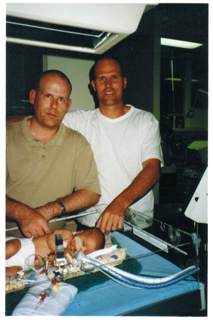 I want to introduce you to Xander, by brother’s son who tragically died about 36 hours after he was born.
This is my own personal experience with child mortality, seeing how my brother and his wife were affected by this bitter and cruel event.
If this is what it feels like when the chances of it happening are so remote, what must it be like when there is a 5:1 change of it happening in communities where young children are not named until their first birthday?
I will take this photograph with me when I leave Sydney. The child mortality I seek to influence is coincident with extreme poverty. This photo, where my brother and I together make a bridge each connected to his young boy gives me some context so that this is not just another string of statistics.
I am sure many people reading this will have their own stories and experiences. Please take time to ensure you address this issue. Please join with me over the coming month to make these experiences have meaning.
There are circumstances that must shatter you

My friend Cori passed on this quote from Leon Wieseltier about a year ago. I liked it and keep in close by in a journal:
There are circumstances that must shatter you; and if you are not shattered, then you have not understood your circumstances. In such circumstances, it is a failure for your heart not to break. And it is pointless to put up a fight, for a fight will blind you to the opportunity that has been presented by your misfortune. Do you wish to persevere pridefully in the old life? Of course you do: the old life was a good life. But it is no longer available to you. It has been carried away, irreversibly. So there is only one thing to be done. Transformation must be met with transformation. Where there was the old life, let there be new life. Do not persevere. Dignify the shock. Sink, so as to rise.
It is blunt, and maybe not the message we want to hear. Sometimes there is no hiding from the roller-coaster that life invites us to ride.
In this TED Talk, Stacey Kramer gives her own experience about an encounter with unwelcome news. It is a short talk at 3:18. Stop and take time to watch this and think about your month ahead.
The next time you are faced with something that is unexpected, unwanted and uncertain, consider that it might just be a gift.
In my next post I will introduce my nephew Xander. A sobering reflection on taking a romantic view about the difficulties we face.
We are so incredibly lucky to be able to reflect about these thoughts from our comfortable surroundings of the West. Might someone in extreme poverty just think that this is all self-indulgent clap-trap?
Training log: October- Pain and Doubts. Running into uncertainty.

October remains a memorable month in my training and preparation. Injury, delays and perseverance to move forward.
I delayed the start of the 10 City Bridge Run three times during the month, often to the frustration of others. The delays were unwanted but also welcome, and caused through insufficient funding and concerns about how the petition would be delivered in Seoul. I still have some concerns about financial backing to ensure that I do not come unstuck half-way through the event.
Delaying the start until the beginning of the G20 Summit was a good decision for a more meaningful delivery of the petition. Analysing other G20 Summits, there is such a media circus and gathering of interest groups that a petition would have had negligible meaning and just been lost in the crowd. Now the decisions that are made (or not made) by the G20 leaders become the focus for the petition, which is a tool to appeal for action holding the leaders to account for the decisions they made.
Early in the month I had great discomfort around my ankles particularly through overtraining combined with insufficient stretching. I introduced more stretches, along with ‘dynamic stretches’ which soon overcame the reduced range of movement and pain.
Throughout the month I have experience significant discomfort in different parts of my calves, which was mostly muscle pain and something that is not uncommon among distance runners.
Presently, since last Wednesday ‘shin splints’ located on the inner left shin became almost unbearable running where running a few metres was not possible. I have been resting my legs and doing a lot of stretching and strengthening exercises. I expect to be fully fit to run by 11 November.
Delays and injury create their own problems with mental preparation creating doubts and uncertainty. Delaying the start of the event creates the hassle of reorganising everything, and concerns over credibility in the eyes of others. This is more a question of perseverance and learning to accept that things change. Ultimately, I have to accept that while I can set a schedule I am not ultimately in control because of the influence of external factors.
I take inspiration from the words of the great aviator Amelia Earhart who was reported missing in 1937 and declared dead in 1939. She truly was a trailblazer”
The most difficult thing is the decision to act, the rest is merely tenacity. The fears are paper tigers. You can do anything you decide to do. You can act to change and control your life; and the procedure, the process is its own reward.
- ← Previous
- 1
- 2
- 3
- Next →
 Building Bridges