Latest Event Updates
Training log: 4 September. 20 km looping Bellevue Hill (Sydney)
 Set out to run 20 km tonight along a course joining Kings Cross- Rose Bay- North Bondi- Bronte- Queens Park- Hyde Park. After reaching Rose Bay while I felt fresh to continue running I was experiencing enough discomfort around my calves to decide to turn around and not complete the journey.
I could have pressed on, and possibly risked over-training. Sometimes it is difficult to listen to the body correctly- am I just a little tired and should dig deep to push a little harder, or is the body trying to signal to me a message to say time to take some rest.
Tomorrow is a rest day, and when my training begins next week I think I will also swim a few laps at the end of each session to give the legs some warm down exercise beside stretching.
Measuring the run for time or heart-rate was not a factor tonight as the goal wasn’t achieved. Rather than seeing this as failure, I will take this as positive information in my training and see how my legs respond next week.
Feeling good and positive about each of the runs over the coming month, and looking forward to a rest day tomorrow.
How much money is enough?…Outrageous and all out of proportion?

A lot has been written about the dispersement and efficacy of aid given towards addressing situations of extreme poverty. Some argue for it from a pragmatic analysis, like Jeffrey Sachs in his book The End of Poverty. Some argue for more of it from an ethical perspective, like Peter Singer does in his book The Life You Can Save. Some argue for a radical review of the current situation from a critical process of inquiry, like Dambisa Moyo in her book Dead Aid: Why aid is not working and how there is a better way for Africa.
Either way you look at it, and you ought to look at it and have an opinion about this issue, a lot of money has been spent, and a lot of money will be spent in the future yet to come. Jeffrey Sachs provides a good overview of how little people live on ‘per day’ if such a calculation was to be defined, with this percentage of the Earth’s population defined as “The Bottom Billion”, because they exist on a bottom rung of income of slightly more than US$1 per day. This line of the economic pyramid, is also defined as people who live at The Bottom of The Pyramid, otherwise referred to as “living below the line”.
“Is more aid or money the answer to extreme poverty?” is reasonably and often among the first questions argued, explored or defended. That is an important question, but this post is not about that.
This post is about the distractions we have in our relatively safe and comfortable lives that take us away from addressing the ugliness of suffering that some people experience. It is reasonable to ask “should we care and is this our problem?” All the same, the power of the media is well documented for its ability to take and hold our attention. Often these issues where our attention is distracted to is very important: the global financial crisis, the failed negotiations in the United Nations Climate Change Conference held in Copenhagen last year, and more recently in Australia a hung parliament where the election held two weeks ago remains stalemated.
Last week I read more about a sexual harassment case that opened in Australia where a $37 million claim for damages was being contested. That is a lot of money, and before the case went to court an offer to settle was made of slightly less than $1 million which was rejected.
As a White Ribbon Foundation Ambassador this year campaigning for the end of violence against women, I take the issue of sexual harassment seriously. In this instance, I question the relative merits of the claim, and the precedence this might set for other claims of a similar nature.
Can we pursue the eradication of extreme poverty in our generation, and at the same time accommodate the values of greed that are so prevalent in our community?
Training log: 3 September. 8 km good pace- broken journey

Tonight a training run of 8 km- set off at a good pace, and feeling good with the previous soreness around the calves. The route was out-and-back from Hyde Park, down Macquarie St and turning to George Street passing through Martin Place. Continuing up Nurses Walk to the Sydney Harbour Bridge and across to Milsons Point.
I opened up to a good pace, a felt some tightness of breath reaching the far side of the Harbour Bridge. I stopped briefly at The Church By The Bridge in Milsons Point seeing they had a “I Heart Kirribilli” display and talked to Des Smith about how the launch event might play out on 11 September. Des was kind enough to offer me two pancakes (delicious!) and after a quick conversation with the locals headed back fresh after a rest stop.
I recorded no time or heart-rate data for the run, and measured weight before and on return. After stretching, I felt fresh for a longer run scheduled for tomorrow.
Global Launch, Sydney- 10 City Bridge Run
Join us for the global launch of the 10 City Bridge Run.
100 people running or walking 2.4 km from Sydney to Milsons Point, meeting for breakfast afterwards just across the bridge.
11 September at 8 am meeting on the Bennelong Lawn, immediately inside the Royal Botanic Gardens, opposite the Sydney Opera House Forecourt. There will be a short brief of what it is about, and how to get to breakfast, then we will set off at 8.30 am. For those who are running, it is a fast course but all uphill climbing all of the way past knockout views of Sydney. If you are walking, enjoy the same view, but it will need to be a brink walk to come in under 30 minutes but easily achievable.
Free to attend. You can register via Eventbrite.
There is a little bit more to just meeting for coffee involved here, so please take time to read the following and also the objectives of the 10 City Bridge Run.
This is the beginning of a journey to frame a pictorial petition to be given to the leadership at the G20 Summit to be held in Seoul this November. In 2015, world leaders and the UN will want to report on their achievement of the eight United Nations Millennium Development Goals, and progress to date has been slow even falling short of what is needed in some areas. If Copenhagen is any measure of what we can expect, leaving important issues only to institutional authorities might lead to further disappointment.
The 10 City Bridge Run is a creative process of inquiry.
Over the course of 30 days later this month I will run 240 km, as detailed in the text a little further below.
To launch on 11 September, 100 people are gathering to run or walk 2.4 km together in under 30 minutes.
This is a symbolic gesture to show that collectively, we can do the same work as one unit in far less time and with far greater collaborative reach.
Starting in New York on 24 September 2010, I will commence the 10 City Bridge Run- a global endurance challenge to raise awareness of the possibly to eradicate extreme poverty affecting children in our current generation.
Running 10 sub-marathons in 10 cities across 10 countries inside of 1 month.
Actually, this project is about much more than just running. Each run is representative of the 24,000 children under the age of five years of age who tragically die daily on average based on the 2008 mortality rate for that year (8.8 million children).
So join us on 11 September. Be part of the difference that makes the difference.
If you are not in Sydney, let us know if you are able to connect with us in one of the other cities where we will be visiting between now and the end of October, and we can hook up with details of dates and locations:
- New York
- Toronto
- Brussels
- London
- St Petersburg
- New Delhi
- Jakarta
- Banda Aceh
- Shanghai
- Tokyo
- Seoul
This is important.
Please take time to ask why you should care.
Thanks for taking time to give this your consideration- see you on the journey!
Training log: 2 September. 9 km slow jog

Was scheduled to run 7 km today, but stepped out on a slow jog and clocked 9 km in total. At the outset I felt fresh although my calves experienced mild discomfort probably due to less than adequate stretching over the past few weeks. I have been stretching for 20 minutes at the end of each session, and feel this is making a difference already.
Given the way my calves were feeling, I took it slow and felt fresh throughout the whole distance. Starting at Hyde Park, I ran down Macquarie Street to circle the Sydney Opera House and run up to the Cahill Expressway overpass. Running to the beginning of the Sydney Harbour Bridge, I descended the stairs and headed to where Hickson Road goes underneath the bridge. I ran along Hickson Road, up to the picturesque Millers Point past the Pallisade Hotel, and rejoined Hickson Road just before Darling Harbour. Continuing to the Sydney Entertainment Centre, I headed up to Liverpool St and finished at Hyde Park.
I did not record time or heart-rate for the run, but did measure weight going out and returning.
Would you prefer if I displayed a map with these blogs of my training log?
Bridge as metaphor…useful as a way of seeing?
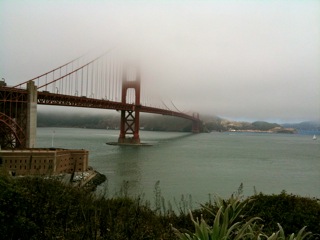 The structure of a bridge is a metaphor I have drawn upon to help define what this work is communicating. Do you think that is appropriate given the complexity of the issue of poverty, and the many stakeholders involved?
Gareth Morgan in his classic 1997 text Images of Organization writes:
Metaphor is often regarded just as a device for embellishing discourse, but its significance is much greater than this. The use of metaphor implies a way of thinking and a way of seeing that pervade how we understand our world generally.
Take how I have defined sponsorship for example: all the parts that make up a bridge are important. Without one bit, the other bits would either collapse, cease to be functional, or be structurally weakened. (Note: Post amended to reflect the new crowdfunding site at http://www.pozible.com/lifebridge) I have drawn upon the architectural definitions of:
- Support: The structure that props up a bridge. Even if a plank is rested across a gap to make a bridge, the two ends are what provides the support.
- Span: Span is defined by wikipedia as the distance between two intermediate supports for a structure. The span is a significant factor in finding the strength and size of a beam as it determines the maximum bending moment and deflection.
- Foundation: The portion of a structure that transfers the weight of that structure into the ground.
What this means in plain terms is that it is the span that provides the functional purpose of the bridge, but without the necessary number of supports a point of weakness is reached through bending under an unevenly distributed load. None of this will matter if the foundation established is not sufficient to carry out the ‘heavy lifting’ needed.
Thanks to those sponsors who have made a contribution to date. None of this would be possible without your engagement. Please also note in relation to support, span, and foundation each is vitally important for the reasons mentioned above.
A bridge is also a structure which enables different functions. As a metaphor, a bridge between people enables the passage of ideas, it connects people who are in different places, it enables help to be connected, it opens up the opportunity for people to be helped, it reduces isolation, it is a more efficient way of getting to another point, it increases the range of options available, and the list continues…
Far from being a facile word-game, I contend that ‘bridges’ are critical in the quest to eradicate extreme poverty. Certainly, just building bridges would be an act of folly if they are built with no purpose or are merely ornamental. To my mind, the process of inquiry of ‘what is not working here, and what are we doing ok at?’ is related to building a bridge. The hundreds of books and articles that have been written about the eradication of extreme poverty are in themselves bridges, as much as the conferences and forums that are held to address the issue.
Let’s build bridges with purpose, and where possible direct our efforts into strengthening and even crossing the bridges established by others in order to make our interest, inquiry and efforts all the more productive.
What is a bridge to you?
Training Log: 1 September. 8 km easy pace.
Heading out from Hyde Park down Macquarie Street then around the Sydney Opera House, the harbour and city lit up like jewels. My run snaked across the Opera House forecourt, on the Cahill Expressway overpass, then crossing the bridge to Milson’s Point. Back on the bridge and retracing my steps again enjoying the night air and the stillness brought to the water by the dark. Once across the bridge, I headed down the stairs toward ‘Nurses Walk’ onto George Street and back up through Martin Place finishing at Hyde Park.
I ran an easy pace, and felt relaxed and in good condition. I recorded no time or heart-rate, but measured weight going out and coming in to see how much was lost to sweat. I spent a good 20 minutes stretching afterwards, leaving me in good shape for training tomorrow.
Achieving the impossible…just a matter of belief and perspective?
While running in Oxford last year, I passed the track where Roger Bannister broke the 4 Minute Mile in 1954. This was a surprise to me, as while I knew he had done that in the past, I didn’t know where it had occurred.

Stop and think just how much of the technology in our world today is made up of what was once considered impossible. The claim that a 4-minute mile was once thought to be impossible by informed observers was and is a widely propagated myth cooked up by sportswriters and debunked by Bannister himself in his memoir, The Four Minute Mile, 1955.
“This race made me realise that the four-minute mile was not out of reach,” Sir Roger Bannister, 2 May 1953 after running 4:03.6 and shattering previous 1945 standard record.
The complexity of extreme poverty is not something to just wish away. The human cost is staggering. The amount spent on aid across the last 30 years beggars belief.
This year is a critical moment to grip up the situation of extreme poverty affecting children in our world. The United Nations is committed to a 2015 timeline. The US has today announced the end of American combat operations in Iraq. The G20 Summit being held in Seoul can take a more informed view of the past and projected impact of the global financial crisis.
Five years might sound like a long time, but it will pass very quickly. There is a great sense of urgency with which we as a global village need to address this problem of seeking an eradication of extreme poverty looking first at a time horizon of 2015. It is one of many problems to address. In Australia, the state of Indigenous health and gap in life expectancy remains a disgraceful legacy of the past. The competing demands across our global village are so complex it is sometimes difficult to comprehend.
“Are you crazy!?” some people ask me about this global endurance challenge, recognising the difficulty in what I am seeking to undertake, just from a logistical perspective alone. I agree, it is definitely a “stretch goal”.
Is it possible:
- to achieve the 10 sub-marathons inside one month
- to successfully finance the journey
- to coordinate the book “Above the Line” so that it is published in time for the G20 Summit
- for a copy of the book to be delivered to each world leader attending the G20 Summit…
While these things might seem fanciful and far removed from the earnest consideration of the reality of extreme poverty, I believe they also are powerful ways to communicate the ability to achieve what is believed to be outside of our grasp.
I can’t do this on my own, and I seek your support. Please consider sponsoring the development of the book “Above the Line”. Together, we can make a difference.
Training Log: 31 August. 8 x 400 m sprints
From Cook and Phillip Pool, I ran down to Sydney Harbour’s gorgeous foreshore at Mrs Macquarie’s Chair located at the Royal Botanic Gardens. Sydney would have to be one of the most scenic cities in which to train.
Measuring out a 400 m stretch, I pounded out the eight laps required by today’s schedule.
I wasn’t wearing a watch or heart-rate monitor, so ran for maximum effort on each lap.
Commencing the running I had some soreness in my lower calves and ankles from the past week’s training, but this soon loosened up allowing me a free stride.
Sprint training can be hard work when your fitness is low. As your fitness improves, the ability to continually run at pace becomes an engaging challenge within one’s self.
The reward from tonight’s training was a spectacular sunset spilt out across a chequer-board pattern of clouds in the sky. Did anyone capture the sunset on camera? Send me a photo, and I will upload in the blog.
G20- the lever for change?
The G20 describes itself as the premier forum for international economic cooperation: “Our goal is to strengthen the global financial system and build a global economy rooted in sustainable growth and prosperity for all”.
What do most of us understand about the G20, its role and purpose? Does it matter that the frequency of the meeting or what it is designed to do is relatively unknown by many people?
I have framed this global endurance challenge between a high-level United Nations meeting to address the status of the Millennium Development Goals in New York and the G20 to be held in Seoul later in November this year. In between is a space when perhaps people ought to discuss what we understand about extreme poverty, is it a problem we should concern ourselves with, and whether in fact it might be possible to eradicate this within a 2015 timeline set by the United Nations.
South Korea is approaching the organising of the G20 Summit to be held during mid-November 2010 with admirable determination. There are many issues to discuss, particularly those relating to the global financial crisis.
What might we expect to see from the G20?
- ← Previous
- 1
- …
- 41
- 42
- 43
- Next →
 Building Bridges